Skip to content

Home › Mobile signal checker

Free tool · Ofcom data · All 4 UK networks

Mobile signal checker — best coverage at any UK postcode

Find the best mobile signal in your area in 30 seconds. Compare predicted EE, Vodafone, O2 and Three coverage — voice, 4G and 5G data, indoor and outdoor — using the same official Ofcom mobile coverage data the regulator's own checker uses. Free, no sign-up, built for UK businesses and homes.

  • Same data as the official Ofcom checker
  • EE, Vodafone, O2 & Three compared side-by-side
  • No email required to see your results
Why our checker

The fastest way to find the best mobile signal in your area

Most people Googling “best mobile signal in my area” end up bouncing between the official Ofcom mobile coverage checker, the EE coverage map, the O2 coverage map, the Vodafone coverage checker and Three’s map — four tools, four interfaces, no straight answer.

We pull all four into one place, score each network 0–100 for your postcode, and tell you which one to pick. If it’s a network we partner with, we can also quote you on it in 60 seconds. If it’s not, we’ll still tell you — we’d rather you got good signal than a bad deal.

  • Real Ofcom data — not a third-party scrape. We’re a licensed user of the Ofcom Connected Nations Mobile Coverage API.
  • All four networks — EE, Vodafone, O2 and Three side-by-side. No need to check four separate coverage maps.
  • Indoor & outdoor — predicted signal both inside an average UK building and outside. Important if your team works from a back office or warehouse.
  • Voice & data, 4G & 5G — we surface call quality and 4G/5G data quality separately, because the two often diverge.
  • Built for business — outdoor data is weighted higher in our score because that’s what field teams, sales reps and engineers actually need.
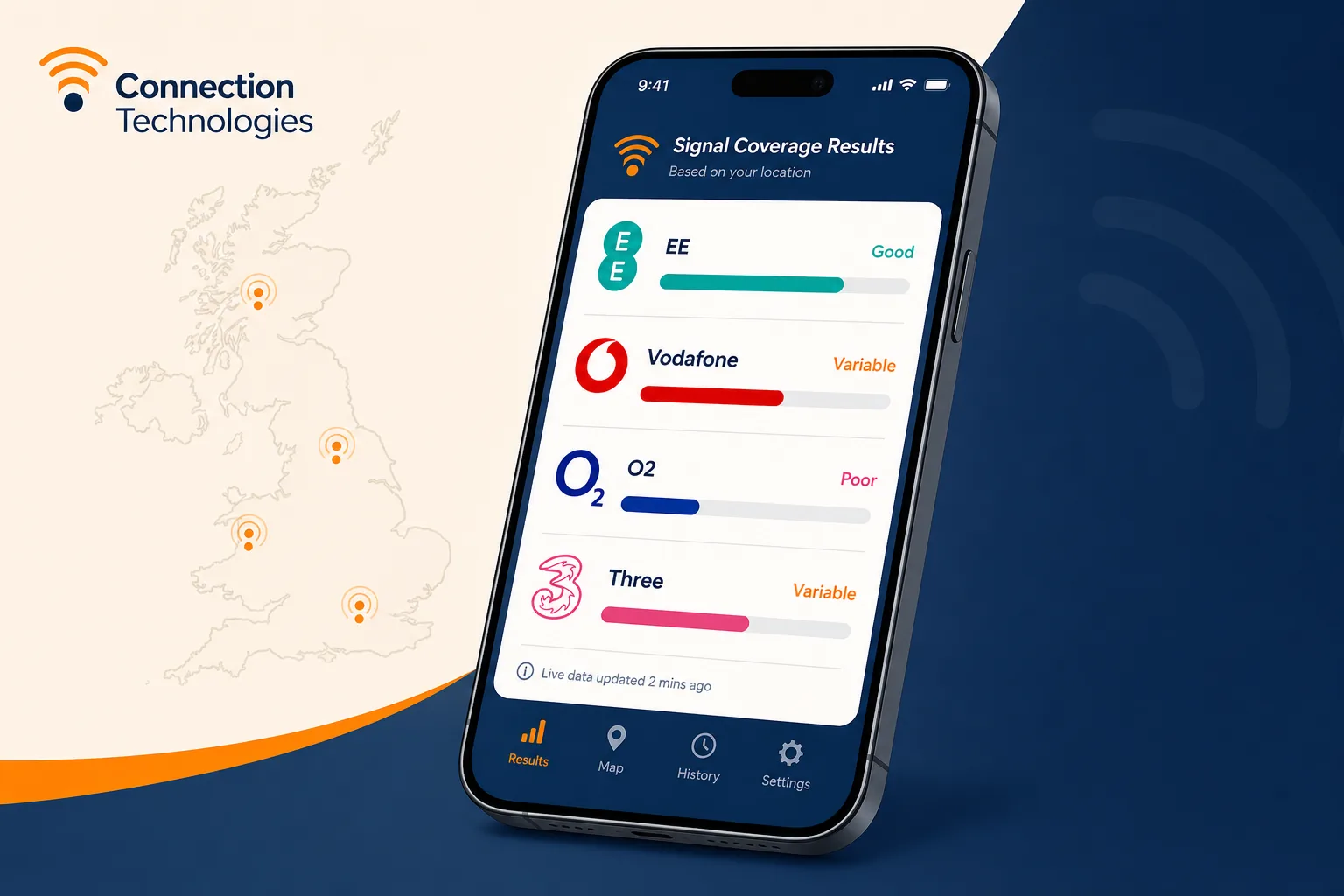
Mobile signal coverage results for EE, Vodafone, O2 and Three displayed on a smartphone
By network

Common UK mobile signal problems — by network

Each of the four UK networks has its own typical weak spots and outage patterns. If you’re searching for “O2 signal problems today”, “EE reception coverage”, “Vodafone signal problems” or “why is Three so bad in my area”, here’s the honest answer — plus what to do about it.

EE

EE signal problems

Strongest UK 4G footprint, but rural Wales, the Highlands and parts of Cornwall still have weak coverage. EE 5G is concentrated in urban centres — it dies fast as you head into market towns.

  • Symptom: “No signal on EE” in newer steel-framed offices — EE’s 800 MHz coverage layer is great outdoors but penetrates modern buildings poorly.
  • Fix: turn on Wi-Fi calling (free on every EE plan since 2017) so handsets fall back to your office Wi-Fi for voice calls.
  • Check: our EE coverage checker guide · official EE coverage map
Vodafone

Vodafone signal problems

Vodafone’s strength is 5G rollout speed (now branded VodafoneThree following the 2025 merger) and consistent voice coverage. Weak spots are scattered: pockets of South West England and rural Yorkshire crop up most often.

  • Symptom: “Vodafone rubbish signal” complaints often follow handset upgrades — new iPhones and Galaxy phones default to 5G SA, which Vodafone is still building out.
  • Fix: in Settings › Mobile Data › Voice & Data, switch from 5G Auto to 5G On (or 4G if 5G is patchy in your area).
  • See deals: Vodafone business offers · official Vodafone coverage map
O2

O2 signal problems

The most-searched signal complaint in the UK. O2’s 900 MHz spectrum gives excellent rural and indoor voice coverage, but its 4G data network has historically lagged EE in capacity, and 5G rollout is still uneven outside major cities.

  • Symptom: “O2 no signal” or “O2 reception down” spikes during major events. Their network status page is honest about live outages — check before assuming it’s your handset.
  • Fix: O2 supports both Wi-Fi calling and 4G calling (VoLTE) on most modern handsets. Toggle both on in your phone’s settings.
  • Check: our O2 coverage checker guide · live O2 service status & outage map
3

Three signal problems

Three has the fastest 5G average download speeds in many UK speed tests, but the smallest geographic footprint of the four networks. Following the 2025 VodafoneThree merger, the two networks are being combined — new business plans are increasingly quoted on the merged Vodafone network.

  • Symptom: brilliant signal in central London, dead spots in market towns. The legacy Three network used to roam onto EE in some areas — that arrangement is being phased out.
  • Fix: if you’re mid-contract on Three with poor signal, you may have a right to early exit under Ofcom’s rules — we cover this in our how to check mobile signal strength guide.
FAQ

Mobile signal & coverage — frequently asked questions

What is the best mobile network for coverage in the UK?
There is no single “best” network for the whole of the UK — it depends on your postcode. EE has the largest 4G geographic footprint, O2 has the strongest rural and indoor voice coverage thanks to its 900 MHz spectrum, Vodafone is leading on 5G rollout (now combined with Three as VodafoneThree), and Three has the fastest 5G in cities but the smallest geographic reach. Use the checker above to see which one is strongest at your address.
How accurate is the Ofcom mobile coverage checker?
Ofcom's coverage data is the most reliable predictive data available in the UK — it’s based on data each operator submits about their masts, modelled against terrain and building density. It’s the source most third-party signal checkers ultimately derive from. That said, predictions are predictions — actual signal varies by handset, building materials (steel frames and foil-backed insulation kill signal), weather, and how busy the local cell is. Treat a good Ofcom prediction as “you should get usable signal” rather than a guarantee.
Why does my phone show full bars but calls still drop?
Bars on your phone show signal strength, not signal quality. You can have full bars from a distant or congested mast where the actual data throughput is poor. The opposite is also true — a single bar from a nearby cell can carry a perfectly clean call. The dBm reading on your phone is a far better indicator: anything stronger than -85 dBm is good, -85 to -100 is workable, weaker than -110 is when calls start to break up.
Will Wi-Fi calling or 4G calling fix poor mobile signal?
Often, yes. Wi-Fi calling routes voice calls over your office or home Wi-Fi when mobile signal is weak — effectively turning your broadband into a backup mobile network. 4G calling (VoLTE) uses the 4G data network for voice calls, which carries indoors much better than legacy 2G/3G voice. Both are free and supported on every major UK network. Turn them both on in your phone settings — we walk through how in our signal strength guide.
Why is O2 signal so bad in my area today?
Two common causes: (1) a temporary outage on the O2 network — check our live O2 outage tracker; or (2) a structural coverage gap. O2’s 5G rollout is still patchy outside major cities, so newer 5G-capable handsets sometimes try to lock onto a weak 5G cell instead of falling back to a stronger 4G one. In phone settings, set Voice & Data to “5G Auto” or “4G” to test.
Does this checker work for business addresses?
Yes — it works for any UK postcode, residential or commercial. We weight the score slightly towards outdoor data because that’s what most field-based business users (sales reps, engineers, delivery drivers) need most. If your team works from a fixed office, indoor voice and indoor data are the columns that matter to you.
How often is the coverage data updated?
Ofcom refreshes the underlying mobile coverage dataset each operator submits roughly every six months. Our cache holds each postcode response for 24 hours to keep the page fast — if you need a real-time check during a known outage, refresh after the cache expires or contact our support team.
Can I use this checker for free, and do you store my postcode?
Yes — it's free, no sign-up required, and we don’t need an email to show you results. We do log postcode lookups in aggregate (postcode + which network won) so we can spot regional coverage gaps and make better recommendations. We do not store your IP address in plain text and we never sell or share lookup data.
I get a poor score on every network — what can I do?
For business premises with genuinely poor outdoor coverage, the practical fixes are: (1) deploy Wi-Fi calling over your existing broadband; (2) install a signal repeater or small cell — these are legal in the UK as long as they're Ofcom-licensed (Vodafone’s Sure Signal and equivalent operator-supplied units); (3) consider 4G/5G failover broadband on a different network from your primary mobile carrier — if EE has weak voice but strong data, we can quote you on an EE data SIM as a backup. Talk to us about poor-coverage solutions ›

How to read your results

Score 0–100

A composite of indoor and outdoor signal weighted to reflect business use (outdoor & data weighted higher than indoor voice).

Voice / Data labels

Enhanced: 5G or strong 4G. Good: usable indoors. Variable: signal can drop. Poor: not reliable. None: no signal predicted.

Indoor vs Outdoor

Indoor predictions assume average UK building materials. Steel, foil-backed insulation and basements all reduce real-world signal.

Why we suggest a network

We recommend the strongest of the networks we partner with (Vodafone & O2). We’ll always tell you if EE or Three is genuinely better.

Need a quote on the best network for your postcode?

Tell us how many handsets and we’ll match the right Vodafone or O2 tariff — free, no obligation, 60 seconds.

Get my quote

Results show predicted coverage from each network operator. Actual signal varies by handset, building construction and weather. Connection Technologies is an authorised business partner for Vodafone and O2; we’ll quote on whichever network gives you the best service. Mobile coverage data © 2026 Ofcom, licensed under the Open Government Licence v3.0.

Sitemap