
DMARC Deployment Plan: p=none to p=reject in 30 Days (UK 2026)
Quick Answer: Move DMARC from p=none to p=reject in four phases over 30 days: week 1 publish DMARC at p=none with reporting; week 2 fix every legitimate sender failing alignment;…
Cyber security articles — Cyber Essentials, MDR, SIEM, ransomware, phishing, ISO 27001, GDPR and compliance for UK SMEs.
Quick Answer: Move DMARC from p=none to p=reject in four phases over 30 days: week 1 publish DMARC at p=none with reporting; week 2 fix every legitimate sender failing alignment;…
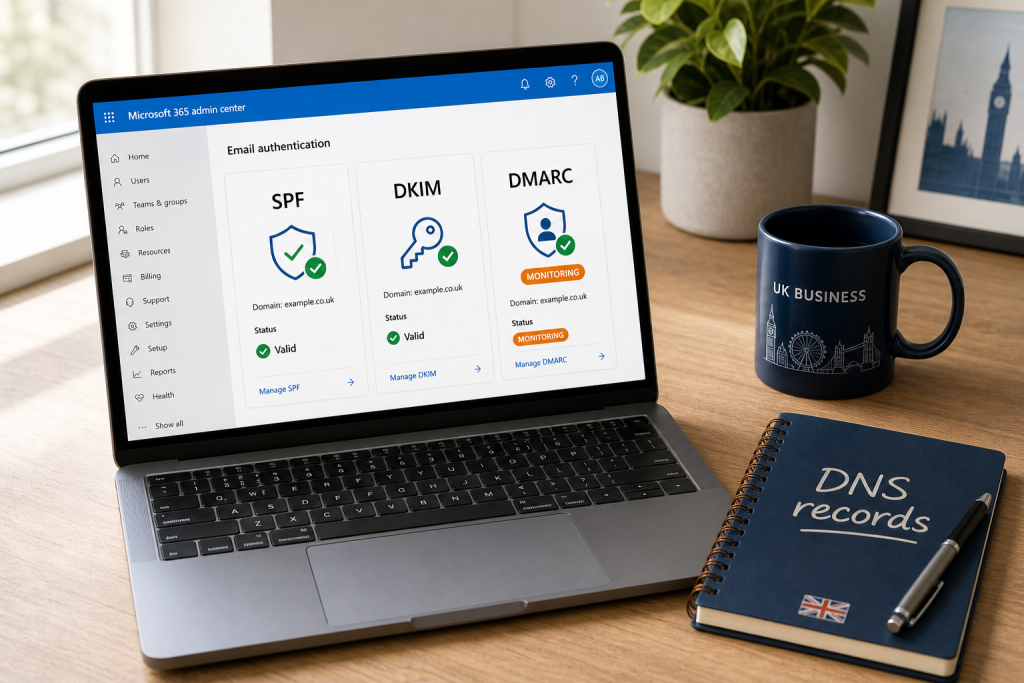
Quick Answer: Microsoft 365 ships with SPF half-configured and DKIM and DMARC fully off. Add a single SPF TXT record (v=spf1 include:spf.protection.outlook.com -all), enable DKIM in Microsoft Defender for both

Quick Answer: Cyber insurance in the UK costs £500–£1,500/year for a small business with £500k cover, rising to £5,000–£25,000/year for mid-market with £5m cover. Most insurers now require MFA, EDR,
Quick Answer: A typical UK SMB spends £15–£30 per user per month on cyber security in 2026 (EDR, email security, training and monitoring), plus £500–£5,000/year for Cyber Essentials or Cyber

Quick Answer: The best EDR (Endpoint Detection & Response) software for UK businesses in 2026 depends on size and budget. CrowdStrike Falcon and SentinelOne Singularity lead the market on detection

Quick Answer: UK accountancy practices are now among the highest-risk sectors for cyber attacks, holding payroll data, tax data and bank-account details for hundreds of clients. ICAEW, ACCA and AAT

Quick Answer: UK law firms face SRA Standards and Regulations 2019 obligations for confidentiality (Principle 6), client money safety, and the SRA’s 2024 sectoral cyber-risk warnings. The Solicitors Regulation Authority

Quick Answer: UK healthcare providers must satisfy the NHS Data Security and Protection Toolkit (DSPT), the Network and Information Systems Regulations 2018, UK GDPR (medical data is special-category), and emerging

Quick Answer: UK schools and academies must meet the Department for Education’s digital and technology standards, including the “cyber security standards for schools and colleges” published in 2022 and updated

Quick Answer: UK charities are a high-frequency cyber target precisely because attackers expect weaker defences than commercial businesses. The Charity Commission’s 2024 risk register flagged cyber as a tier-1 risk;
Quick Answer: Business Email Compromise (BEC) is now the highest-loss cyber crime against UK businesses, costing more than ransomware in financial terms. Action Fraud and the FBI’s Internet Crime Report
Last updated: 11 June 2026 Quick Answer: AI-driven phishing and deepfake-enabled social engineering are now the fastest-growing cyber threats to UK businesses. Generative AI has dramatically improved phishing realism (no
