

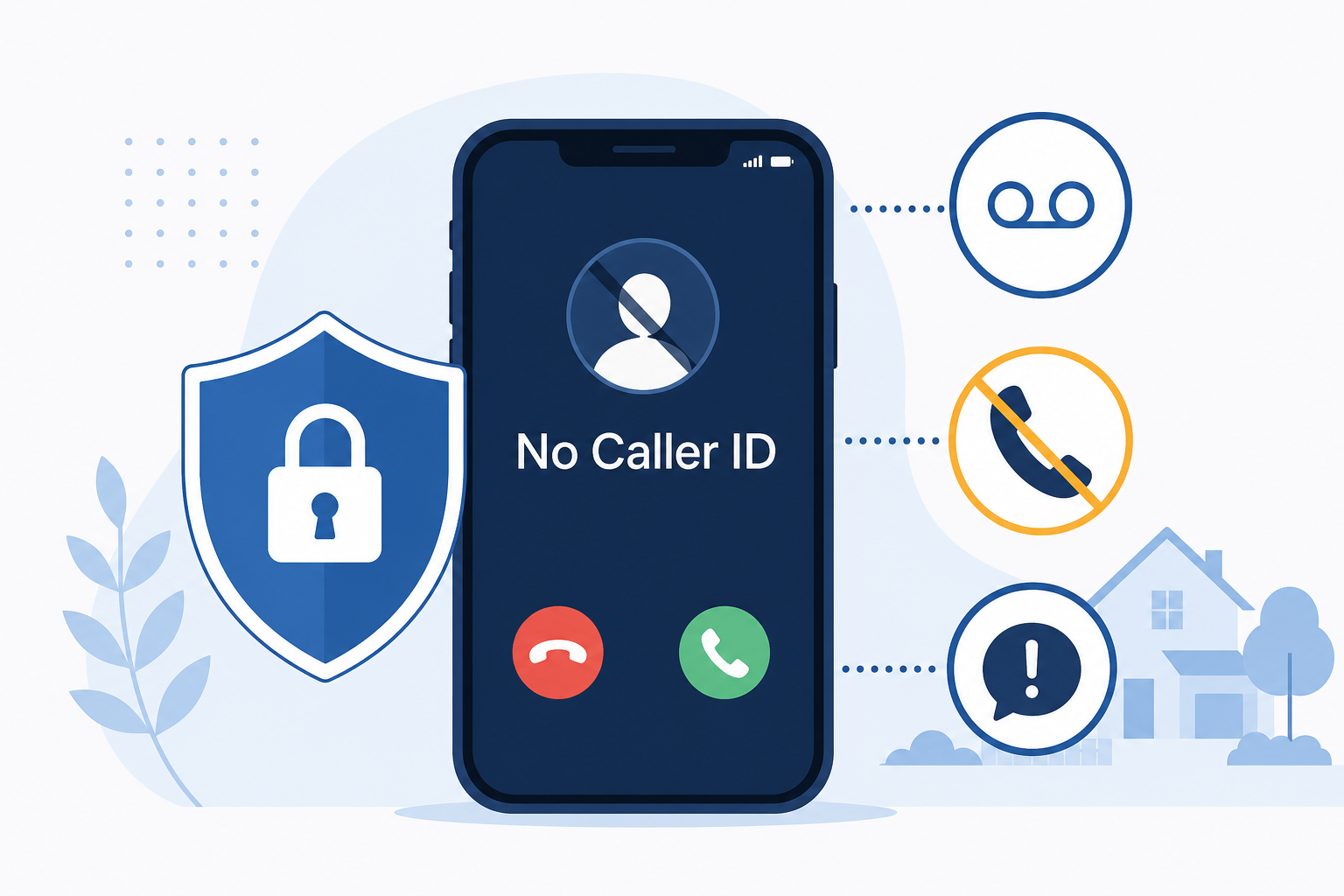
A No Caller ID UK call can be unsettling because your screen gives you no number to check. It does not prove the call is fraudulent, but you should not disclose information or send money to an unexpected caller.
This guide explains what the label means, what your network may know, and the safe steps you can take. For a broader prevention checklist, read our guide to blocking and reporting unwanted calls.
At a glance: No Caller ID facts on 10 July 2026
- Withheld means the caller chose not to present their number to you.
- Unavailable usually means the network could not supply a usable number. It does not always mean the caller pressed a privacy option.
- A phone app or public lookup service cannot override a valid privacy marking and reveal a withheld number.
- Your provider may offer caller display, call filtering, anonymous call rejection and voicemail services.
- Registering with the Telephone Preference Service can reduce unsolicited marketing calls, but it cannot stop every unwanted call.
- Forwarding to 7726 is for suspicious texts, not calls. Scam phone calls follow different reporting routes.
What does No Caller ID mean in the UK?
Caller ID is based on Calling Line Identification, often shortened to CLI. Ofcom explains that CLI data includes the caller’s line identity and a privacy marking. That marking tells providers whether the identity may be shown to the recipient.
When a caller uses a valid withholding option, your provider respects that privacy choice. Your phone may show “No Caller ID”, “Private number” or “Number withheld”. The exact label depends on the handset and network.
Withholding has legitimate uses. A clinician, police officer, support worker or employee calling from a personal line may not want that number shared. Ofcom also warns that hospitals, emergency services and utility companies may sometimes withhold numbers.
Withheld and unavailable are not the same
A withheld number normally arrives with a privacy indication. The communications network has line identity data, but the recipient is not allowed to see it.
An unavailable number means usable caller information was not delivered to your service. This can happen because of network routing, an overseas call, an older system or a technical fault. The display alone cannot tell you why it happened.
A visible number brings a different risk: it can be spoofed. Ofcom says misuse of CLI data can mislead recipients about who is calling. Therefore, even a familiar number is not proof of identity.
Can you find out who called from No Caller ID UK?
Not through a legitimate consumer app, dial code or public website. A withheld number is not sent to your handset for display. Software installed on that handset cannot reveal information it did not receive.
Claims that a service can “unmask” every hidden caller should be treated with caution. Do not install unknown software, pay a tracing fee, or provide account credentials. These steps may create a second security problem without identifying the caller.
Communications providers may hold network records that are not available to customers. Ofcom notes that CLI data can support regulatory and enforcement action. That does not create a general right for a customer to demand the caller’s number.
For repeated malicious, abusive or threatening calls, contact your provider’s nuisance or malicious calls team. Give them the dates, times and what was said. If there is an immediate threat or danger, call 999.
What about 1471?
Some landline services offer Last Caller Identification, often reached through 1471. It can announce a number only when one is available to the service and may not work after a withheld call. Check availability and charges with your provider.
There is no universal prefix that forces a private number to appear after the event. Codes mentioned on social media may relate to another country, a particular operator or a different feature.
Do No Caller ID tracker apps work in the UK?
No app can reveal a deliberately withheld UK number, because the number is never delivered to your handset in the first place — software cannot display data it did not receive. Call-identification apps such as Truecaller or Hiya work differently: they match visible incoming numbers against crowd-sourced spam databases, which is useful for screening but irrelevant to a withheld call.
Some overseas services advertise “unmasking” of anonymous calls by diverting your calls through their own systems before they reach you. These are built around US carrier features; UK networks do not generally support the same diversion, and routing your calls through an unknown third party creates a privacy risk of its own. Be especially wary of any app that charges a tracing fee or asks for your account credentials — that is a common secondary scam.
If the calls are malicious rather than just unknown, skip the apps entirely: your provider’s nuisance-calls team and, where necessary, the police can act on network records that no consumer app can access.
What to do when a hidden number calls
You do not have to answer. Letting the call reach voicemail is often the safest first filter. A genuine caller with an important reason can leave a name, organisation, callback number and short explanation.
Do not assume voicemail proves identity. If a message claims to be from your bank, provider, HMRC, the police or another trusted body, find its official contact details yourself. Do not use a number supplied by the caller until you have verified it independently.
- Do not disclose passwords, one-time codes, card details or remote-access information.
- Do not move money to a “safe account” because an unexpected caller tells you to.
- Do not be rushed by threats, secrecy or a short deadline.
- End the call, wait a few minutes if using a landline, then contact the organisation through a trusted channel.
Our guide to the most common UK phone scams explains the pressure tactics criminals often use. A hidden number is only one warning sign; the caller’s request and behaviour matter more.
Voicemail and network options
Ofcom lists phone services that can help, including caller display, incoming call blocking, anonymous call rejection and voicemail. Features, prices and names differ by provider, so ask what is available on your line.
Anonymous call rejection blocks callers who withhold their numbers. It may also stop legitimate calls from organisations that use withholding. Consider whether you expect calls from hospitals, public services or staff working from private lines before enabling it.
Incoming call filtering may ask unknown callers to identify themselves before your phone rings. Network voicemail can also screen calls when your phone is off, busy or unanswered. Some providers offer enhanced protection for people who are vulnerable to nuisance calls.
Ask your provider these questions:
- Can it reject deliberately withheld calls, and is there a charge?
- Does its filter distinguish withheld calls from visible but unknown numbers?
- Can important callers leave voicemail when a call is rejected?
- Does it have a nuisance or malicious calls team for repeated incidents?
How to silence or block hidden calls on iPhone and Android
Phone settings can reduce interruptions, but they do not identify the caller. They may also affect calls from visible numbers that are not saved in your contacts. Review voicemail and missed calls so you do not overlook a genuine message.
iPhone
Open Settings and search for “Silence Unknown Callers”. On many iPhone versions, it appears under Settings > Apps > Phone. When enabled, calls from people outside recognised contacts and recent interactions may be silenced and sent to voicemail.
The feature is broader than a No Caller ID block. Delivery drivers, surgeries, schools or new business contacts may also be silenced if their numbers are not recognised. Menu names and behaviour can change after an iOS update.
Android and Samsung phones
In the Phone app, open the menu and look under Settings > Blocked numbers or Block numbers. Google, Samsung and other manufacturers use different labels, such as blocking “unknown” or “private” numbers.
Read the description before switching it on. On one device, “unknown” may mean a hidden caller; on another, it may include unsaved visible numbers. Your mobile network may offer a separate filter if the handset option is too broad.
Keep useful evidence without trying to trace the caller
A short record helps your provider or the relevant authority understand a pattern. The ICO asks for as much information as you can provide, although you do not have to answer every complaint question.
- Record the date, exact time and call duration.
- Take a screenshot of the call-log entry showing the hidden-call label.
- Save the voicemail in its original form where your phone allows it.
- Write down the claimed organisation, caller name and purpose.
- Note requests for money, personal data, codes, downloads or remote access.
- Keep any related texts, emails, links or payment details.
Do not secretly publish recordings or personal allegations online. Preserve evidence for your provider, police or regulator. If calls are repeated, keep a simple chronological log rather than relying on memory.
How to report hidden nuisance and scam calls
The correct route depends on what happened. You can still report a call even when no number appeared. The absence of a number may limit what you can supply, but the time, content and claimed organisation remain useful.
Nuisance marketing calls
The ICO handles nuisance marketing calls, including unwanted live sales calls and automated marketing messages. Its guidance recommends free registration with the Telephone Preference Service to opt out of unsolicited telesales calls.
TPS registration does not block calls technically. It also does not remove consent you previously gave to a specific organisation. Tell that organisation directly that you withdraw consent and want marketing calls to stop.
Scam calls and losses
The NCSC’s scam-call guidance says to report fraud or cybercrime to Report Fraud in England, Wales and Northern Ireland. In Scotland, report it to Police Scotland on 101. Contact your bank immediately if money or banking details are at risk.
7726 is for suspicious texts, not calls. If a suspicious call is followed by a text, you can forward that text to 7726. Our UK scam-text reporting guide explains that separate process.
Silent, abandoned, abusive or threatening calls
Ofcom deals with complaints about silent and abandoned calls. For malicious, abusive or threatening calls, contact your phone provider immediately and ask for its nuisance or malicious calls team. Call 999 when a threat is immediate.
Have a visible number instead?
A number checker can only help when your call log shows a number. It cannot reveal a withheld or unavailable caller.
Check a visible UK phone number
Presenting a clear, visible number on your own outbound calls also gets more of them answered — a virtual business number adds a professional 07 or local line without a new SIM.
Frequently Asked Questions
No. Your phone has no visible number to dial. Wait for a voicemail, and verify any claimed organisation through contact details you find independently.
No. Legitimate organisations and individuals may withhold a number for privacy. Treat an unexpected request for money, passwords, codes or remote access as the stronger warning sign.
Not as a routine customer lookup. Providers may hold network records for operational, regulatory or enforcement purposes. Report repeated malicious or threatening calls so the proper process can be followed.
It can reduce them, but settings and network services differ. A broad filter may also silence legitimate callers whose numbers are withheld or not saved in your contacts.
Yes. Supply the date, time, what the caller claimed and what they asked you to do. Keep voicemail and related messages, and use the reporting route that matches the incident.
Official sources
- Ofcom: Calling Line Identification guidance
- Ofcom: phone services that can help tackle nuisance calls
- ICO: nuisance calls
- ICO: report spam texts and nuisance sales calls
- NCSC: report a scam phone call
Written by Andy Pickett
Last reviewed: 10 July 2026
If hidden calls keep disrupting you, start with voicemail screening and then ask your provider about anonymous call rejection. Keep a dated record and report any harmful pattern through the route above.
Related Reading
More from the Connection Technologies blog.