

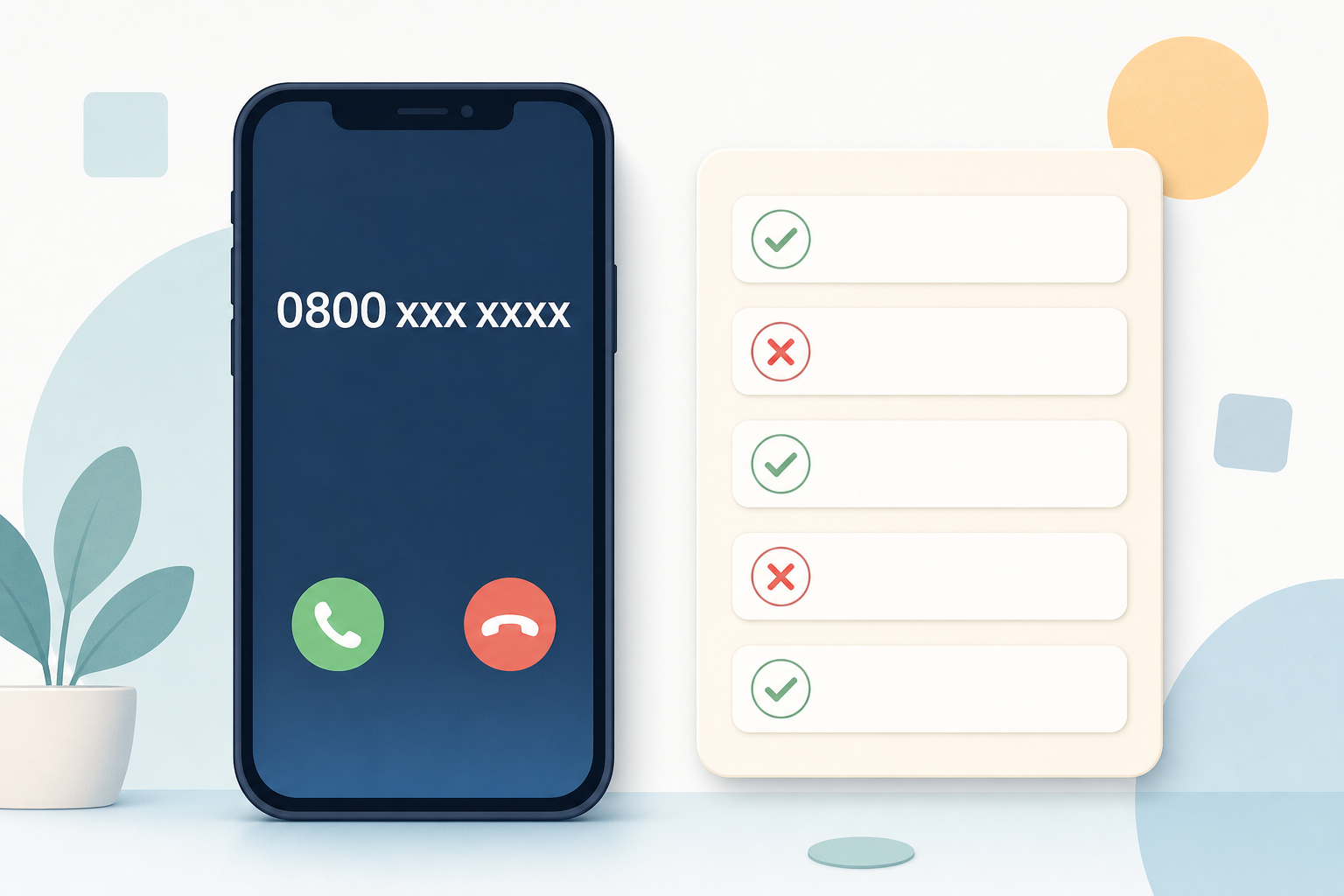
An 0800 number scam check is now an essential step before trusting any inbound freephone call in 2026. For decades, an 0800 prefix carried an aura of official legitimacy — banks, utilities and government departments advertised them, so callers assumed an 0800 caller must be “real.” That assumption is no longer safe. Scammers can buy an 0800 number from a VoIP reseller for less than the cost of a coffee, spoof an existing 0800 as caller ID, or set up a callback line that pretends to be your bank’s fraud team. This guide explains exactly how to verify an 0800 caller, what the seven most common 0800 scam plays look like in 2026, and the steps to take if you’ve already given details. If you want to check the specific number that called you, you can run it through our free UK phone number checker before doing anything else.
Why 0800 Carries an Undeserved Aura of Trust
0800 was introduced in 1985 as the UK’s freephone range and was initially restricted to large organisations that could afford the per-minute inbound charges. For the next twenty years, almost every 0800 number you saw belonged to a household-name bank, a national charity, a utility or a government helpline. That created a strong cultural shortcut: “an 0800 number must be a real company.”
The economics changed completely after deregulation and the rise of VoIP. Inbound rates dropped, virtual number resellers proliferated, and 0800 became another non-geographic range any business — or any criminal — could lease. The “freephone equals legitimate” assumption stuck around in the public mind long after the underlying market had changed.
Scammers actively exploit that legacy trust. A spoofed 0800 caller ID will pass the gut check of “is this number safe?” for many people, especially older callers who remember when 0800 really did mean “official.” That cultural lag is the entire engine of modern 0800 scams.
How Easy It Is to Buy an 0800 Number in 2026
Setting up a genuine working UK 0800 number in 2026 takes about ten minutes and costs less than ten pounds a month. There is no licensing, no Ofcom approval, no identity check beyond a normal business bank account, and in many cases not even that.
The typical path is:
- Sign up to a virtual-number reseller online (dozens exist, from large telcos to small VoIP-only providers).
- Pick from a list of available 0800 numbers — memorable patterns cost more, random numbers are usually free.
- Pay £4–£15 per month for the number and a per-minute rate for inbound calls (typically 2–5p from landlines, 7–15p from mobiles).
- Point the number at any phone — a mobile, a softphone app, a call-centre platform.
There is no central register of who owns which 0800 number. Ofcom allocates blocks of numbers to communications providers; those providers then assign individual numbers to their customers and are not required to publish ownership. That information asymmetry is exactly why number lookup tools and reputation databases exist. For background on freephone economics generally, our Are 0800 numbers free from mobile? full guide explains the pricing in depth.
The 7 Classic 0800 Scam Plays in 2026
Almost every 0800 scam fits one of seven scripts. They evolve at the edges, but the core structure has been stable since around 2022.
1. Bank Fraud Team Callback
The caller claims to be from your bank’s fraud team and says suspicious transactions are being attempted on your account right now. The 0800 caller ID often matches — or is one digit off — the freephone fraud line printed on the back of your bank card. You are walked through moving money to a “safe account.” There is no safe account; the money is gone.
2. Energy Refund or Smart-Meter Booking
“You are owed £384 from your previous supplier.” The caller claims to represent an “energy refund department” or “Ofgem fund administrator” and just needs your bank details to process the payment. A variant offers a “smart-meter engineer slot” with a small refundable deposit. Neither Ofgem nor any genuine supplier works like this.
3. Broadband Cancellation / Speed Compensation
Caller pretends to be from BT, Sky, Virgin Media or TalkTalk, often using a spoofed 0800. You are told your broadband is being “cancelled” or that you are owed compensation for slow speeds. The endgame is either a remote-access install on your computer or a card-payment “to reactivate.”
4. HMRC and DWP Impersonation
Pre-recorded “press 1 to speak to an officer” messages claim there is a warrant for your arrest or a tax investigation. Spoofed 0800 caller IDs make the call feel official. HMRC never threatens arrest by phone, never demands payment in gift cards or crypto, and never calls about benefit fraud in this way.
5. Fake Charity Cold Call
An 0800 caller claims to be from a recognised charity (often a children’s, military veterans’ or animal welfare cause) and asks for a regular direct debit. Some are real but aggressive cold-call agencies; others are pure scams. Always verify on the Charity Commission register before agreeing to anything.
6. Lottery or Prize Draw “You’ve Won”
An 0800 line says you have won a prize draw, holiday or cash sum and need to pay an “administration fee” or “courier charge” to release it. No legitimate UK lottery or prize draw asks winners to pay anything to receive their prize.
7. “We’ve Detected Suspicious Activity on Your Account”
The most generic of all 0800 scripts. The caller claims to represent your bank, your broadband provider, Amazon, your network or HMRC and says suspicious activity has been detected. The exact “account” is left vague so the script works on anyone. Resist the urge to ask which account they mean — that engagement is what they want.
For real-time visibility into which numbers are currently scamming UK consumers most, check our most reported scam numbers page — many of the freephone-prefix numbers in the top of that list rotate weekly.
Genuine 0800 Use-Cases — When It Really Is the Bank
It would be wrong to claim every 0800 caller is a scam. Most major UK organisations still run real 0800 lines, including:
- Banks for fraud alerts (although in 2026 most banks default to in-app push notifications and SMS instead of outbound calls)
- NHS 111 telephone advice and follow-up clinical services
- Utility emergency lines (gas leaks, water bursts, power cuts)
- National Domestic Abuse Helpline (0808 2000 247) and the Samaritans (116 123 free, 0808 164 0123)
- Citizens Advice consumer helpline (0808 223 1133)
- Government departments for benefit and tax queries (often 0800 or 0345)
The defining feature of a genuine 0800 call is that it can survive verification. A real bank fraud team will happily wait while you call them back on the number printed on your card. A scammer cannot.
The 5-Step 0800 Number Scam Check Protocol
Memorise this protocol once and use it every time. It works regardless of the scam category.
- Hang up. Politely say “I’ll call you back” and end the call. A genuine caller will never object to this.
- Wait at least five minutes before making any outbound call. Scammers can hold your landline open after you “hang up,” so you dial the supposed number and the same scammer answers. Five minutes guarantees the line is clear.
- Find the real number from a trusted source. The back of your bank card, the official .gov.uk page, the printed bill, or the company’s own website typed into the browser by hand. Never use a number the caller gave you, and never click a link in an SMS.
- Cross-check the number. Look it up on our free UK phone number checker or check Companies House and the FCA Register for the organisation the caller claimed to represent.
- Call back from a clean line. Ideally a different phone (a mobile if the original call was on a landline). If the original caller was real, your verified call will reach the right team and the matter can continue.
If you want to see how this works on a specific lookup, try this specific 0800 lookup example from our number database. The same approach works for any 0800, 0808 or 0345 number you don’t recognise.
Lookup Sources That Actually Help
Five free UK sources cover almost every legitimate organisation worth verifying.
- Companies House (find-and-update.company-information.service.gov.uk): Confirms a UK limited company exists, who the directors are and the registered office. Anything not listed there is at best a sole trader and at worst entirely fictional.
- FCA Financial Services Register (register.fca.org.uk): The authoritative list of every firm authorised to provide financial services in the UK. Any caller offering investments, loans, insurance or “money management” must be on this register.
- Charity Commission Register (register-of-charities.charitycommission.gov.uk): Confirms registered charities, their official phone numbers and current financials. Scam “charity” calls rarely match a real entry.
- The organisation’s own website: Typed by hand into the browser. Cross-check the published phone number against the one calling you.
- Our own free UK phone number checker: Aggregates UK user reports, area code data and risk signals for any number. The reverse phone lookup directory covers every UK prefix range, including 0800. You can also browse the full 0800 area-code overview for context on how the freephone range is structured and allocated.
For a deeper dive on how mobile networks decide which numbers to label as suspicious in the first place, see our companion piece on iPhone ‘Spam Likely’ label explained.
Spotting the “Official Number on a Sticker” Trick
One of the most under-reported 0800 scams in 2026 doesn’t involve a phone call at all — initially. Scammers print high-quality stickers showing a fake “Official Support Line” or “Customer Care” 0800 number and stick them on bank ATMs, train ticket machines, charging points, parking meters and shop windows.
When the machine misbehaves or a customer panics about a transaction, they call the “official” number. A scammer answers, takes them through the fraud-team script, and money disappears.
How to Tell a Fake Sticker
- The sticker is slightly off-centre, partially covering the original branding
- The phone number doesn’t appear anywhere on the organisation’s own website
- The “support” number is an 0800, but the bank’s real fraud line on the back of your card is different
- The sticker is suspiciously fresh-looking on weathered equipment
If you spot a fake sticker, do not call the number. Report it to the bank or the operator of the equipment using their published channels.
What to Do AFTER You’ve Shared Details with a Fake 0800
If you have already given information to what now feels like a fake 0800 caller, act fast. Most loss happens in the first ninety minutes.
- Freeze the card immediately in your banking app. Monzo, Starling, HSBC, Barclays, Lloyds, Nationwide, NatWest, Santander, Halifax, First Direct and Revolut all support instant card freeze.
- Call your bank using the number on the back of your card. Tell them you’ve been scammed and ask them to apply a watch on the account.
- Change any password you mentioned or that could be guessed from what you said. Use a different device if you typed it on a compromised computer.
- Report to Action Fraud: actionfraud.police.uk or 0300 123 2040. Get a crime reference number — your bank will ask for it.
- Forward any related SMS to 7726 — the free UK shortcode for reporting suspected spam and scam texts to your mobile network.
- Tell someone you trust. Scammers often follow up the first call with a “compliance officer” or “police” call telling the victim not to discuss the matter. Talking to a family member breaks that isolation.
Under the October 2024 Payment Systems Regulator (PSR) rules, most authorised push payment (APP) fraud is reimbursed by UK banks up to £85,000 within five business days, provided you reported it promptly and were not grossly negligent.
Reporting to Your Network, FCA, Action Fraud and Ofcom
Reporting matters even if you didn’t lose money. Each report feeds into network-level filters and FCA enforcement.
- Your mobile network — 7726: Forward any related SMS to 7726, or text “Call” to 7726 to report a suspect voice number. Works on EE, Vodafone, O2, Three, Sky Mobile, BT Mobile, Tesco Mobile, giffgaff and all major MVNOs.
- Action Fraud: The UK’s national reporting centre for fraud and cybercrime. Online at actionfraud.police.uk or call 0300 123 2040 (8am to 8pm Monday to Friday).
- FCA (for financial services impersonation): If the scammer pretended to be a bank, investment firm, insurance company or loan company, report at fca.org.uk/consumers/report-scam-unauthorised-firm.
- Ofcom: ofcom.org.uk for nuisance calls and silent calls. Ofcom uses reports to enforce against UK-based offenders and to push network-level filtering improvements.
- The Information Commissioner’s Office (ICO): For unsolicited marketing calls (ico.org.uk) if you are signed up to the Telephone Preference Service.
- The bank being impersonated: Banks have dedicated fraud-reporting addresses. Forward suspect emails to report@phishing.gov.uk (the NCSC’s Suspicious Email Reporting Service).
You can also help others by adding the scammer’s number to public reports on our most reported scam numbers page. Public reports drive network filters and search results, which directly shortens the useful life of any individual scam number.
Why More Businesses Should Adopt 03 Numbers Instead of 0800
For legitimate UK businesses, the trust problem cuts both ways. As more people learn that 0800 is no longer automatically trustworthy, the marketing value of a freephone number declines. Sophisticated customers — particularly under-forties — increasingly treat any unsolicited 0800 call with suspicion.
The 03 range was created in 2007 specifically to give organisations a national, non-geographic number that is treated as a normal “inclusive minutes” call by every UK mobile and landline plan. From the caller’s wallet, 03 is as free as 0800 for most people. From a perception perspective, 03 has never carried the same scam baggage.
- 0345 numbers are widely used by banks for non-fraud lines
- 0300 numbers are reserved for charities, government departments and public services
- 0333 numbers are the default for most modern UK SMEs
If your business is currently weighing 0800 against the cost of inbound minutes, our piece on 03 numbers — the modern alternative to 0800 walks through the per-minute economics. 03 also removes one common 2026 problem: outbound 0800 calls are now disproportionately filtered as “Spam Likely” by mobile carriers precisely because so many scammers use the prefix. For more on how carriers decide what to label, see iPhone ‘Spam Likely’ label explained.
Red Flags Inside the Call — Phrases Real 0800 Lines Never Use
Genuine UK bank, utility, NHS and government 0800 lines stick to a small set of predictable language. Scam scripts give themselves away in the language they use because they are translated, generated by AI, or designed to manufacture urgency.
Phrases that should set off an immediate alarm:
- “For security reasons, please confirm your full date of birth, full address and the long card number.” A real bank already has all of this. They will only ever ask for a few specific digits or a one-time passcode they have just texted you.
- “Don’t end this call until we have completed the security checks.” No real fraud team objects to a callback. Real banks actively prefer you to call them back on the printed number to prove the line is clean.
- “We need you to install a small piece of software so we can verify your computer is secure.” No legitimate UK organisation needs you to install AnyDesk, TeamViewer, UltraViewer or any remote-access tool to “verify security.”
- “Your money has been moved to a holding account in your name.” Banks do not move customer money to “holding accounts” by phone. APP fraud is literally defined by this script.
- “This call is being monitored and recorded by HMRC investigators.” HMRC does not say this on outbound calls and does not initiate enforcement by phone.
- “To stop the cancellation of your broadband, please confirm payment now.” No UK ISP demands an inbound payment to “stop a cancellation” they have just announced over the phone.
- “This number is for fraud team only, do not share it with anyone.” A real organisation has no reason to demand secrecy about a phone number you can verify on their public website anyway.
Vocal and Background Cues
AI voice scripts are good but not perfect. Listen for:
- Unnaturally smooth pacing with no “umms,” coughs or page-turn sounds
- An accent that doesn’t match the geography the caller claims (a “London office” with the rhythm of a non-UK call centre)
- A complete absence of typical office background noise — no other agents, no keyboards, no door noise
- Long pauses while the caller “checks your account” that suggest the script branching, not a real database lookup
Geographic Patterns of 0800 Scams in 2026
Although freephone numbers are non-geographic, the human operators running the scams cluster in identifiable patterns. UK consumer reports submitted to Action Fraud and to mobile-network filters cluster strongly around six origin types:
- UK-registered VoIP resellers leasing numbers to overseas call centres
- Numbers spoofed entirely from outside the UK (the caller never owned the displayed number)
- Short-lived numbers leased for two to six weeks and discarded once reports accumulate
- Recycled numbers that previously belonged to a legitimate business and still appear on old marketing
- “Memorable” 0800 numbers leased specifically because they look professional in spoofed caller ID
- Numbers leased under shell companies that are dissolved before any enforcement action lands
Time-of-day patterns are also telling. Genuine UK organisations rarely call outside 9am to 6pm on weekdays. Scam 0800 traffic peaks in two windows: weekday evenings (6pm to 9pm) targeting people back from work, and weekend mornings targeting older landline owners. If you receive an “urgent” 0800 fraud team call at 8.45pm on a Sunday, that timing alone is a red flag.
What to Tell Vulnerable Family Members About 0800 Scams
The highest-risk group for 0800 impersonation is people aged 70 and over, particularly those who live alone and still use a landline as their primary phone. Three short rules cover almost every scenario and are easy to remember.
- Rule 1: No bank ever sends a courier, asks for cash, or asks you to move money to a “safe account.” If you hear any of these three things, the call is a scam, full stop. There is no exception.
- Rule 2: Always hang up and call back on the number on the back of your card. Even if the call sounds perfectly real. A real fraud team will never object.
- Rule 3: Always tell someone in the family before sending any money you weren’t expecting to send. The “don’t tell anyone” line is itself proof of a scam.
Print these three rules and put them next to the landline. Mobile networks now block most spoofed bank fraud-team calls before they reach the handset, but landlines have far fewer protections — which is why scammers preferentially target them.
Setting Up Protective Defaults
Two small changes reduce risk dramatically:
- Ask BT (or whoever provides the landline) to add free anonymous-call rejection and a premium-rate / international outgoing bar. Both are free or near-free and stop a large class of scam traffic.
- Set the bank account to require a second-factor confirmation for any new payee. This adds five seconds to legitimate payments and removes the entire “move money to a safe account” attack vector.
Need a Genuine 0800 Number for Your Business?
A freephone number builds instant trust with customers. Get your own 0800 number set up in 24 hours with call routing to any phone.
How 0800 Scams Fit the Wider 2026 Scam Landscape
An 0800 number scam check is one piece of a much bigger puzzle. The same psychological levers — urgency, authority, isolation, unusual payment methods — appear in WhatsApp recruitment scams, AI voice clone “emergencies,” courier card-collection scripts and pig-butchering investment frauds. The 0800 prefix is just the surface; the underlying engineering of consent is identical across formats.
If you want the full picture, our top 10 UK phone scams 2026 guide covers every common scam type and how each one’s call pattern fits the network filters now in place. For the regulatory side — particularly what happens when numbers are released or reissued and start receiving the previous owner’s traffic — see our explainer on Ofcom number reallocation rules.
One final point worth keeping in mind: the technology will keep moving. Network-level scam filtering will keep improving, but so will AI voice cloning, RCS smishing and live spoofed-number injection. The five-step protocol above is intentionally low-tech precisely because it does not depend on any particular network feature. Hang up, wait, find the real number from a trusted source, cross-check, and call back. That habit will outlast every iteration of the scam economy. Bookmark our free UK phone number checker on the device you usually answer calls from, share the three vulnerable-family-member rules above, and the next 0800 caller will find a much harder target.
Related Guides
- Are 0800 numbers free from mobile? full guide
- 03 numbers — the modern alternative to 0800
- top 10 UK phone scams 2026
- iPhone ‘Spam Likely’ label explained
- Ofcom number reallocation rules
- free UK phone number checker
Frequently Asked Questions
Yes. Anyone with a UK business bank account — and sometimes just an email and a card — can lease a working 0800 number from a virtual-number reseller for £4 to £15 a month. There is no Ofcom approval, no licensing and no central public register of 0800 ownership, which is exactly what scammers exploit. The 0800 prefix on a caller ID proves nothing about the caller’s identity.
Hang up, wait five minutes, find the organisation’s real number from a trusted source (the back of your bank card, the official website typed by hand, .gov.uk or Companies House), and call back from a clean line. Never use a number the caller gave you, even if it looks identical. You can also cross-check the inbound number against our free UK phone number checker to see if other people have reported it as a scam.
Yes. Since 1 July 2015, all calls to UK 0800 and 0808 numbers are free from every UK mobile and landline, regardless of the caller’s price plan. That free-to-call status applies to scam 0800s too — the call is still free for the caller, but the business or scammer running the line pays the inbound termination cost. Free to call is not the same as safe to call.
Freeze any affected cards in your banking app, then call your bank using the number on the back of your card and ask them to apply a fraud watch on the account. Report the incident to Action Fraud at actionfraud.police.uk or on 0300 123 2040 and get a crime reference number. Under the 2024 PSR reimbursement rules, most authorised push payment fraud is refunded by UK banks up to £85,000 within five business days, provided you reported it promptly.
There is no public UK register of 0800 ownership. Ofcom allocates blocks of freephone numbers to communications providers, which then assign individual numbers to their customers without publishing ownership data. The best practical alternatives are crowd-sourced lookup tools that aggregate user reports — our free UK phone number checker shows how many people have reported a specific 0800 and what they said about it.
No — and arguably it is less safe, because the prefix carries undeserved legacy trust. The safest signal of a legitimate caller is not the prefix; it is whether the number matches the one published on the organisation’s official website or on the back of your bank card. Treat 0800 with exactly the same caution as any other unknown caller, and always verify before sharing details.
Related Reading
More from the Connection Technologies blog.