

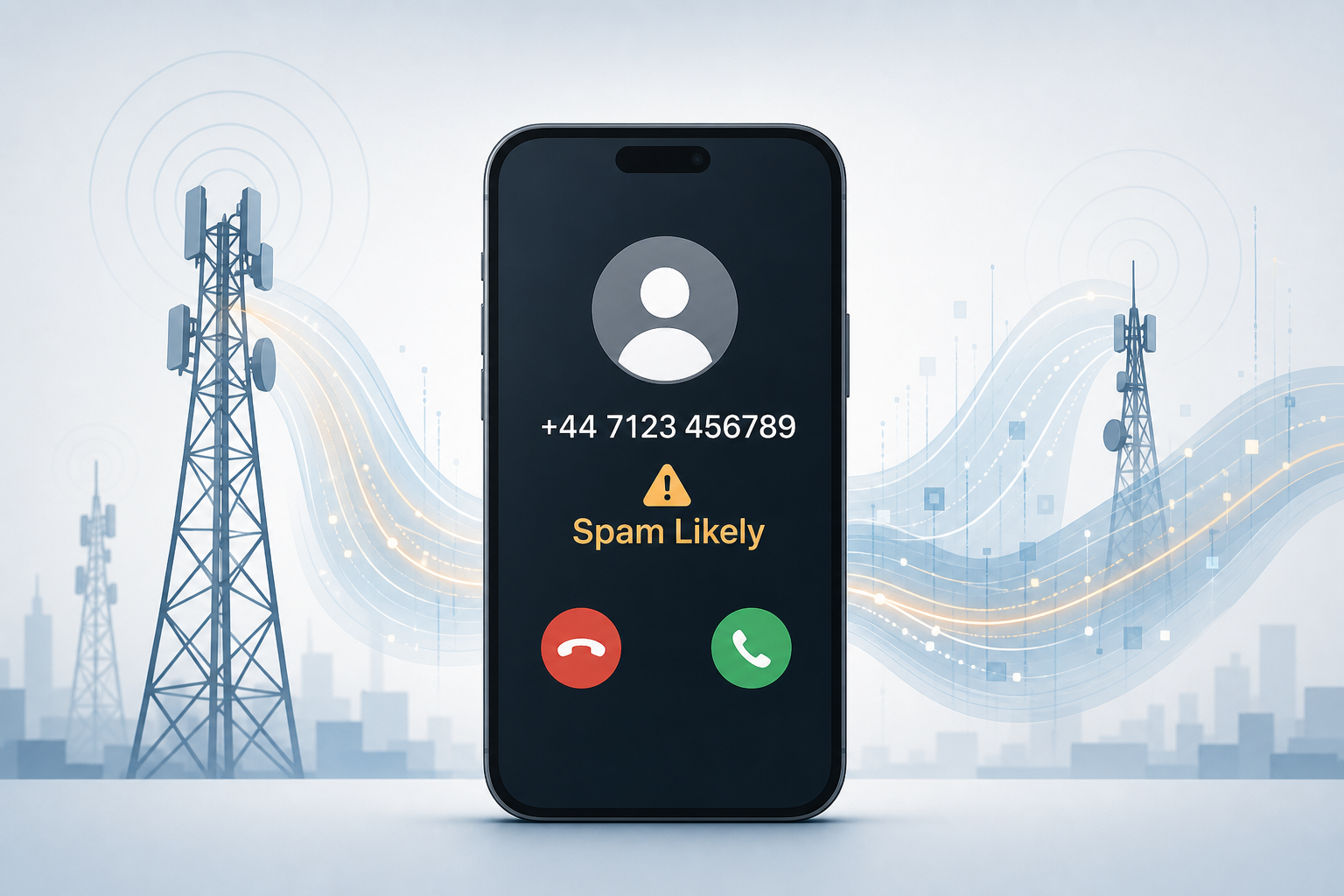
Open your iPhone, see an incoming call from a UK number, and underneath it in red the words “Spam Likely”. Most people assume Apple is doing the labelling. Almost no one is. The iPhone spam likely UK tag is generated by the mobile network carrying the call — EE, O2/VMO2, Three, Vodafone or Sky — and pushed to your handset over the SIP signalling layer. iOS just displays whatever the carrier sent. Understanding that distinction is the difference between sensibly silencing junk and accidentally blocking a legitimate sales lead.
If you run a UK business and your own number is now showing up as “Spam Likely” to your prospects, this article walks you through why, how the scoring really works in 2026, and what you can do about it. We cover what each UK network actually measures, where STIR/SHAKEN sits in the Ofcom roadmap, the most common reasons a legitimate number suddenly gets flagged, and the documented dispute routes that genuinely work. Along the way you can use our free UK phone number checker and reverse phone lookup directory to test what your number looks like today.
What “Spam Likely” Actually Is — It’s the Network, Not iOS
Apple does not run a spam-scoring service of its own. iOS has hooks for one (the CallKit Call Directory extension), and Apple supports the in-call label, but the actual decision about whether a number is “Spam”, “Telemarketer” or “Fraud” is taken upstream by either the originating network, the receiving network, or both. The label arrives at your iPhone as a string attached to the call’s caller-ID payload, and iOS simply renders it.
That is why the same number can show as “Spam Likely” on an EE handset and clean on a Vodafone handset. The two carriers operate independent scoring engines and only partially share threat data. It is also why turning iOS features on and off — Silence Unknown Callers, Focus modes, blocked numbers — has no effect on whether the label appears. iOS is the messenger.
This matters in two practical ways. First, if you want to dispute a label on your own business number, you must do it through the carrier that is tagging you, not through Apple. Second, if you want to filter unwanted calls more aggressively, you need a third-party app that does run a scoring service on the device — Hiya, Truecaller, RoboKiller — because Apple’s built-in tools only honour the carrier label, not extend it.
How Each UK Network Produces a Spam Score in 2026
Each UK network maintains a slightly different stack. Here is what we know from operator briefings, Ofcom consultation responses and recent transparency reporting.
EE / BT Group
EE’s spam-detection engine is the most aggressive in the UK market. It blends in-house call-pattern analysis (call duration distribution, calls-per-minute thresholds, time-of-day clustering) with Hiya threat intelligence and complaints data from BT consumer customers. EE was the first UK carrier to deploy network-side AI scoring at scale, originally in 2022, and the engine now reaches roughly 96% of mobile customers. Numbers identified are flagged as “Spam Likely” with about 40 million daily decisions across the BT network.
O2 / VMO2 (Virgin Media O2)
O2’s “Call Defence” runs on a combination of TNS Call Guardian (a US-headquartered carrier intelligence platform) and proprietary VMO2 signals. The tagging granularity is finer than EE’s — VMO2 distinguishes between “Likely Nuisance” and “Likely Fraud” and pushes these as separate labels. VMO2 also operates the largest opt-in “Call Defence” subscriber base in the UK as of mid-2025.
Three UK
Three relies more heavily on third-party intelligence (Hiya is the primary partner) and historically has not deployed as much in-house AI as EE or O2. The label on a Three iPhone is therefore more likely to mirror Hiya’s reputation database. With Three’s merger into Vodafone now operationally bedded in, the two carriers are converging on a single scoring pipeline through 2026.
Vodafone UK
Vodafone runs “Smart Calling” with First Orion as its primary intelligence partner and an internal ML layer added during 2024. Vodafone is also the most likely UK network to display branded-calling rich caller ID (logo, business name) for verified business numbers, which directly competes with “Spam Likely” as a label format.
Sky Mobile
Sky Mobile, as an MVNO on Vodafone’s network, inherits Vodafone’s spam scoring but adds its own customer-complaint feedback loop. Sky also pushes a slightly different label string (“Possible Spam” in some cases instead of “Spam Likely”), which surfaces identically on iOS.
The cumulative effect is that there is no single UK “spam list” — there are five, with imperfect overlap. A number that is flagged on EE may take days or weeks to be flagged on Vodafone, or may never be flagged at all if it does not trigger that network’s heuristics.
The Data Sources Behind a Spam Score
Every UK carrier’s scoring engine combines four broad categories of input. Understanding them is the key to understanding why a legitimate number can suddenly be flagged.
Call Pattern Analysis
This is the workhorse signal. Each network watches for:
- Calls per minute from a single number above a network-specific threshold (typically 10–30 calls per minute for sustained periods)
- Median call duration under 6 seconds (indicating a high hang-up rate, common in nuisance dialling)
- Call-to-answer ratios below 8%
- Repeated calls to numbers on Do Not Call lists
- Pre-recorded message detection on outbound calls
- Time-of-day clustering inconsistent with normal business hours
Complaint Volume
Each network ingests user-side complaints — reported via the “Mark as Spam” button in the iOS recents list (which actually does pass back to the carrier on most UK networks), in-app reporting via My EE, My O2 and so on, plus the Ofcom-published 7726 SMS report stream. A number with more than about 25–40 complaints in a rolling 30 days is virtually guaranteed to be flagged on every UK network.
Community Report Sites
Sites like Who Called Me, ShouldIAnswer.co.uk, TellOnline, NumbersDB and several others feed into the major carrier intelligence partners (Hiya, TNS, First Orion). A surge in negative reports on these sites against a particular number typically leads to a spam flag on every UK carrier inside 7–14 days.
AI / ML Signals
Networks increasingly run neural models on the call-detail-record (CDR) stream that score against thousands of features simultaneously — geographic dispersion of called numbers, similarity to known-bad number profiles, voice-pattern fingerprints (where the network is in the audio path), and behavioural drift from historical norms. EE’s model in particular catches “burner” SIPs that spoof legitimate UK ranges within minutes of the first call.
STIR/SHAKEN — Where the US Is, Where UK Is in 2026
STIR/SHAKEN is the technical standard for cryptographically signing caller-ID information so the receiving network can verify it has not been spoofed. It has been mandatory in the US since June 2021 and has materially reduced wholesale spoofing on US mobile networks.
The UK story is slower. Ofcom’s “Tackling scam calls” programme has been signalling STIR/SHAKEN-style attestation since the 2022 consultation, and the December 2023 statement set out a roadmap for caller-ID authentication on UK networks. The position in 2026 is:
- BT, EE and Vodafone have rolled out limited internal attestation on inter-carrier calls
- O2/VMO2 deployed Phase-1 attestation across its IMS core in Q4 2024
- Full UK STIR/SHAKEN is not yet mandated — Ofcom has indicated 2027 as the realistic target for industry-wide adoption
- An interim measure — the Ofcom-led “Do Not Originate” list, blocking calls that spoof numbers that should never make outbound calls (HMRC, government, banks) — is live and effective
The practical consequence is that until UK STIR/SHAKEN is fully deployed, spam detection in the UK remains a probabilistic, behaviour-based exercise rather than a cryptographic one. That is exactly why so many legitimate businesses get caught in the false-positive net — the carriers cannot prove the call is genuine, so they fall back on pattern matching.
Why a Legitimate Business Number Suddenly Gets Flagged
The single most common support call our business IT support team receives in this category goes: “Our main number was clean last week and is now showing as Spam Likely. We have not changed anything.” Almost always, one of the following has actually changed.
Outbound Call Volume Spiked
A campaign, a product launch, a sales push, even a customer-recall email triggering inbound-to-outbound returns can lift call-per-minute averages above the carrier threshold. The label appears within hours.
Average Call Duration Dropped
If a new dialler script causes more hang-ups, or you started using voicemail-drop, average call duration falls. Below 6 seconds median, you are statistically indistinguishable from a robocaller from the network’s point of view.
You Started Using a New Outbound SIP Trunk or DDI Range
A “cold” number (one with no historical positive signal) is treated with much more suspicion than an established number. If you ported a new range, brought up a new trunk or started using a previously-quiet DDI, you will likely be flagged within the first thousand calls.
Customers Are Reporting You
Almost every iPhone in the UK has a “Mark as Spam” option in the call history. A handful of frustrated customers can move the needle, especially if your outbound number is already borderline on other signals.
The Number Has History You Did Not Know About
If you took on a number through a number-porting acquisition or were assigned a DDI that was previously used by a less reputable operator (debt collection, lead generation), the historical complaint score follows the number. The current 2026 norm on UK carriers is to give a “fresh start” only after about 90 days of clean usage.
The False-Positive Cost to a B2B Business
The reputational and revenue impact of a wrongly-labelled outbound number is bigger than most marketing leaders realise. Independent research published by Hiya in early 2025 shows that:
- 76% of UK iPhone users decline calls that show as “Spam Likely” without listening to voicemail
- Of the 24% who answer, more than half hang up within 10 seconds
- The voicemail-listened rate on a “Spam Likely” voicemail is under 12%, versus 41% on a clean caller-ID call
For a B2B sales team running outbound, the practical translation is that a “Spam Likely” flag depresses connect rates by 60–70%. A sales floor that was making 300 connects a week pre-flag often falls to 90–120 connects a week post-flag. Pipeline impact follows mechanically.
There is also a brand-trust cost. Customers and prospects who see your business name labelled “Spam Likely” — even briefly — form a memory of it that survives the un-flagging process. We have seen account-based marketing campaigns require deliberate re-engagement steps (email follow-up, calendar bookings, second-channel outreach) to recover the prospects who were exposed to the flag during the affected window.
How to Remove an iPhone Spam Likely UK Flag — Hiya, FreeCallerID and Carrier Routes
The good news is that there are documented routes to clear an iPhone spam likely UK label, though none are instant.
Step 1: Identify Where You Are Flagged
Test your outbound number from a device on each of the major UK networks — EE, O2, Three, Vodafone and Sky — and record the exact label shown. Tools like Hiya’s “Reputation Lookup” and TNS’s “Number Reputation Score” can also tell you where you appear in the major carrier intelligence feeds.
Step 2: Submit a Hiya Connect Business Profile
Hiya feeds spam intelligence into EE, Three, Samsung, Truecaller and many smaller MVNOs. Submitting a verified business profile via Hiya Connect (free for SMEs, paid for higher volumes) usually clears the “Spam Likely” label across the Hiya-fed carriers within 5–10 working days. The Hiya profile also enables branded caller ID on participating handsets.
Step 3: Submit a FreeCallerIDDB Profile
FreeCallerIDDB is a UK-friendly free service that lets you publish your business identity against your DDI range. It is consumed by several smaller MVNOs and by the community reporting sites. It will not directly clear an EE or O2 flag but it removes negative momentum from the community data.
Step 4: Use the Carrier Dispute Routes
Each major UK carrier offers a business dispute route:
- EE / BT — submit a “Number Reputation Dispute” via your account manager or the BT Wholesale portal. Typical turnaround 7–14 working days.
- O2 / VMO2 — submit through the VMO2 Business “Call Defence Review” form. Turnaround 5–10 days.
- Three / Vodafone — through Vodafone Business “Smart Calling Profile” submission. Turnaround 5–14 days.
- Sky Mobile — automatically inherits the Vodafone resolution.
Step 5: Address the Root Cause
Clearing a label without fixing the behaviour that caused it is wasted effort — you will be flagged again within weeks. Reduce calls per minute, lengthen average call duration, improve answer rates and stop calling Do Not Call list numbers. Where appropriate, route outbound through a different DDI to give the original number time to recover its reputation.
Setting Up “Silence Unknown Callers” Without Missing Real Leads
On the receiving end, iOS gives you several tools to manage spam without relying purely on the carrier label. “Silence Unknown Callers” (Settings > Apps > Phone > Silence Unknown Callers in iOS 18+) routes any number not in your contacts straight to voicemail.
For consumers this works well. For businesses it is dangerous. Sales prospects, recruiters, suppliers, your bank’s fraud team and your accountant all call from numbers that are not in your contacts. A complete silence-unknown setting can suppress 30–40% of legitimate inbound calls.
A better setup for a business iPhone is the layered approach:
- Keep Silence Unknown Callers off, but enable iOS’s built-in “Spam” routing under Phone settings so carrier-flagged calls auto-silence
- Install a single spam-blocker app (Hiya or Truecaller) with the iOS Call Directory extension enabled
- Configure Focus modes (“Work” / “Personal”) to silence unknown callers only outside business hours
- Use call-divert on iPhone to send unanswered calls to a voicemail box you actually check — see our guide to call divert on iPhone
- Configure voicemail properly — see UK voicemail numbers for the per-network setup
What Apps Actually Work — Truecaller, Hiya, RoboKiller, iOS Silence
If the carrier label is not enough, four spam-handling tools dominate the UK iPhone market in 2026.
Truecaller
Truecaller has the largest community database globally, with about 400 million active users feeding it. On iOS it works through the Call Directory extension — a one-time enable in Settings > Apps > Phone > Call Blocking & Identification. UK coverage is solid for consumer scam ranges but less reliable for B2B-relevant flags. £3.49/month for the ad-free Premium tier.
Hiya
Hiya is the intelligence partner behind several UK carrier scoring engines, so installing the Hiya consumer app gives you essentially the same data the carrier is using. The free tier is sufficient for most users; Hiya Premium (£3.99/month) adds extended fraud blocking.
RoboKiller
RoboKiller’s differentiator is “answer bots” — recordings that engage robocallers in pointless conversations to waste their dialler time. Useful, but the UK community database is thinner than Truecaller or Hiya. £3.99/month.
iOS Native
The built-in “Silence Unknown Callers” plus carrier label is the lowest-friction option and costs nothing. It is also the most likely to over-block legitimate calls. Best used in combination with a contact-import discipline (every prospect you talk to gets saved).
How the Apps Stack on iOS
It is worth knowing how these tools interact under the hood. iOS allows a single active Call Directory extension at a time per category, and each app maintains its own database of identified numbers that gets refreshed on a schedule (typically every 24 hours). If you have Truecaller and Hiya both enabled, iOS uses both lists with Hiya’s typically taking precedence when there is a conflict, but battery drain and lookup latency climb noticeably. For most UK business users we recommend choosing one app and sticking with it for 90 days before evaluating whether to switch — the longer single-app history materially improves the accuracy of “this is a known good caller” decisions.
The Future — Branded Calling, RCS Verified, AI Voice Scam Vector
Three forces are reshaping the UK spam-call landscape between now and 2028.
Branded Calling Display
Apple’s Business Connect now lets verified businesses register a logo, brand name and call reason that appear on iOS call screens in place of “Unknown” or “Spam Likely”. UK adoption is increasing through 2026 across the major carriers. The technology is delivered via the same caller-ID payload that carries spam labels, but it requires the business to verify itself with Apple and the originating carrier.
RCS Verified Messaging
Apple Messages on iOS 18+ now supports RCS, including verified-sender chevrons for business messages. The same trust infrastructure (Google’s RBM, Apple’s verification) is starting to inform voice-call scoring. A business that maintains a verified RCS profile is materially less likely to be flagged on voice.
AI Voice Scams
The flip side: generative voice cloning has matured fast. UK Action Fraud reports a 340% rise in voice-cloned scam calls from January 2024 to January 2026. Carriers are responding by deploying audio fingerprinting and behavioural scoring on calls — which inevitably catches some legitimate calls in the net as collateral. Expect false-positive rates to rise temporarily during 2026–2027 before tooling matures.
For businesses, the practical takeaway is to invest now in branded-calling registration and verified messaging, because those positive signals are the most effective counterweight to the increasingly aggressive spam-scoring engines. Our notes on business phone insurance and damage costs apply too — a robust fleet plus a verified outbound identity is the modern UK B2B baseline.
How to Test Your Own Number’s Reputation in 2026
Before you can fix a flag you need to know exactly which networks are flagging you and how. The practical testing routine takes about 30 minutes and should be repeated every 30 days for any outbound-heavy business line.
Multi-Network Test Calls
The most reliable test is to place a call from your business number to a known device on each of the major UK networks — ideally an unlocked iPhone running a current iOS, with no spam-blocker apps installed. Record exactly what the call screen displays. The same number can show clean on one carrier and “Spam Likely” or “Possible Fraud” on another, and you need to know which is which to file the right disputes.
Reputation Lookup Tools
Hiya, TNS Call Guardian and First Orion all publish free business-facing lookup tools that report how your number is currently scored in their intelligence feeds. These three providers are between them consumed by every major UK carrier, so a clean rating across all three is a strong indicator that you are not currently flagged anywhere.
Community Site Audit
Search your number on Who Called Me, ShouldIAnswer.co.uk, TellOnline and NumbersDB. A pattern of recent negative reports — particularly multiple reports per week with similar wording — almost always precedes a network-level flag by 7 to 14 days. Catching the trend early gives you time to investigate the underlying call behaviour before the spam label arrives.
Internal Call-Pattern Audit
Pull a 30-day report from your PBX or sales-dialler. Look at calls per minute by hour, median call duration, answer-rate distribution and concentration of calls to any single area code. If your numbers look more like a robocaller than a salesperson, you are about to be flagged — fix the behaviour now rather than waiting for the carrier label.
Operator-Level Reporting and Per-Range Reputation
Because each UK network operates its own scoring engine, the reputational health of a number range can vary by carrier. Connection Technologies publishes per-range, per-operator spam-call reports — for example you can check EE-range spam-call reports to see how a given prefix is being scored across community reports and carrier intelligence in 2026. Pair this with the free UK phone number checker to verify a specific number’s status before you call back.
For broader scam-awareness context, we also maintain a current list of the top UK phone scams of 2026 and a quick checker to answer the question “is that 0800 number genuine?” — both directly relevant if you are trying to distinguish a real call from a scam after your iPhone has flagged it.
What to Do Right Now
If your iPhone is showing “Spam Likely” on legitimate calls, or if your own business number is now flagged, the practical action list is short:
- Test your outbound number on all five UK networks and record the result.
- Register on Hiya Connect and FreeCallerIDDB — both are free for small businesses.
- File a dispute with each carrier where you are flagged.
- Investigate the call-pattern behaviour that triggered the flag and adjust it.
- For long-term protection, register with Apple Business Connect and submit your branded-calling profile.
- Re-test after 14 days, then again at 30 days.
If you would like a hand mapping all of this against your existing telephony stack — number ranges, SIP trunks, sales-dialler config, call-divert rules — talk to our team. A typical engagement runs through your last 90 days of call patterns, identifies which DDIs are flagged on which networks, files the dispute submissions on your behalf, and recommends behaviour changes that prevent the issue recurring. For B2B sales teams seeing connect rates collapse, the recovery window is usually 14–28 days from engagement to clean flag across all five UK carriers. Get a quote: Business Mobiles or Hosted VoIP.
Frequently Asked Questions
The label is generated by the UK mobile network carrying the call — EE, O2/VMO2, Three, Vodafone or Sky — and pushed to the iPhone in the caller-ID payload. iOS only displays it. Apple does not run an in-house spam-scoring service, which is why the same number can show as Spam Likely on one UK carrier and clean on another.
The most common causes in 2026 are a sudden spike in outbound call volume, a drop in average call duration (typically below 6 seconds), a fresh untested DDI range, complaint volume from recent recipients, or a residual reputation from a previous owner of the number. Fix the root cause first, then file dispute submissions with each carrier where you are flagged.
It silences every call from a number not in your contacts — which in practice means you also silence sales prospects, recruiters, suppliers and your bank’s fraud team. For business iPhones we recommend leaving Silence Unknown Callers off and instead using iOS’s built-in spam routing combined with a single spam-blocker app like Hiya or Truecaller.
Partially. BT/EE and Vodafone have rolled out limited internal attestation and VMO2 has Phase-1 STIR/SHAKEN live on its IMS core. Ofcom has signalled 2027 as the realistic target for industry-wide UK STIR/SHAKEN. In the meantime, the UK relies on probabilistic, behaviour-based scoring plus the Ofcom Do Not Originate list to combat spoofing.
Submit a Hiya Connect business profile (free for SMEs), publish a FreeCallerIDDB record, file a Number Reputation Dispute with each affected UK carrier, and fix the call-pattern behaviour that triggered the flag in the first place. Carrier turnaround is typically 5–14 working days. Re-test on each network after 14 days and again at 30 days.
No. A Spam Likely label still rings your iPhone and still records in your call history — it just adds a warning. A blocked call is dropped before it reaches you. UK networks generally only outright-block calls that fail Do Not Originate checks or trigger explicit fraud signals; everything else is labelled and the user decides what to do.
Related Reading
More from the Connection Technologies blog.