

One UK Partner for Telecoms and IT: How SMEs Cut Vendor Sprawl in 2026
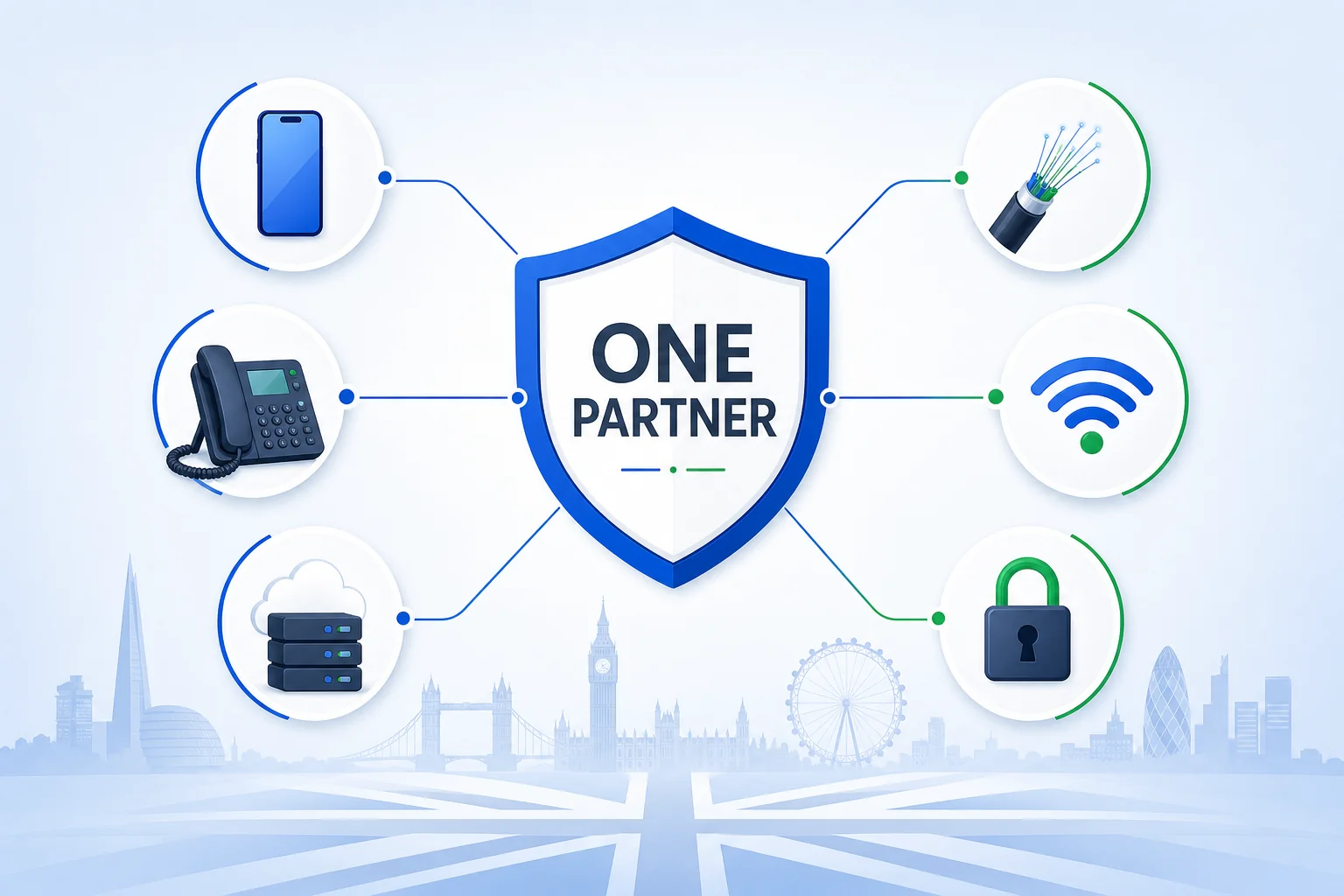
Most UK SMEs juggle five to ten different suppliers for mobiles, VoIP, broadband, Wi-Fi, IT support, Microsoft 365, cyber security, mobile device management and back-up. The result is messy contracts, overlapping costs and gaps that nobody owns. Choosing a single IT and telecoms partner closes those gaps, simplifies billing and gives you one accountable team for everything that plugs into your business.
Key takeaways
- Most UK SMEs (10–250 staff) run 5–10 separate suppliers for things one good partner can deliver under one contract.
- Consolidating to a single managed IT and telecoms partner typically saves 15–30% on monthly spend while cutting issue-resolution times by more than half.
- Connection Technologies packages everything into three named bundles: Connected Office, Connected Field Team and Connected Multi-Site.
- One contract, one bill, one named UK account manager — and one team that owns the entire stack from broadband to cyber.
In this guide
Pair with the pricing principles: See how Connection Technologies prices, contracts and bills — including broker independence and the six commitments of The Honest Bill Promise — in Transparent Business Telecoms Pricing (UK 2026).
Are we the right fit for you? Before consolidating, take the 8-question self-check in our published Right-Fit Map for growing UK SMEs — we’d rather tell you we’re not the right partner than waste your time.
The vendor-sprawl problem nobody talks about
Walk into any UK SME between 10 and 250 staff and ask the office manager — or whoever has accidentally inherited "the IT" — to list every technology supplier the business pays. The answer is almost always uncomfortable. Mobiles from one network, broadband from another, the phone system from a regional VoIP reseller, IT support from a local one-person band, Microsoft 365 sold direct, the Wi-Fi installed by an electrician, mobile device management bolted on by a fourth party, and a separate cyber product the insurer made them buy.
Each of those suppliers signed a different contract, on a different end date, billed on a different cycle, with a different account manager (or none) and a different out-of-hours number that nobody can find at 7pm on a Friday. The ICO's 2025 SME tech survey put the median number of distinct technology suppliers at seven, and the average finance team is reconciling between four and six monthly invoices for what is, functionally, one stack.
The cost of that fragmentation is real, but mostly invisible. It hides in:
- Wasted time. Office managers averaging 4–6 hours a week chasing suppliers, raising tickets, and replaying the same context.
- Finger-pointing. "Your IT support says it's a phones problem; the phones supplier says it's an internet problem; the internet supplier says it's an IT problem." Productivity dies in that triangle.
- Security gaps. Each supplier owns one slice. The seams — the bits between mobile, M365, MDM and back-up — are where the breach happens.
- RPI sprawl. Six suppliers each tacking 5–10% onto next year's bill is a stealth 8% cost increase on the whole stack.
- Strategic blindness. Nobody is paid to look at the full picture. So nobody does.
The single-partner promise: one contract, one bill, one team
The brief from UK SMEs is consistent: "give us one provider that can manage all of it." The Semrush AI Operations research that informed this guide pulled out three repeating phrases from real SME enquiries — "one point of contact", "one easy-to-understand invoice", and "single accountable partner".
That's the heart of the Connection Technologies promise. We deliberately built the company around three words: single contract, single bill, single support team. Every service we sell — business mobiles, hosted VoIP, business broadband, managed IT support, Cyber Essentials, managed detection & response, mobile device management and Microsoft 365 — sits on the same contract framework, the same monthly invoice, and the same UK-based service desk.
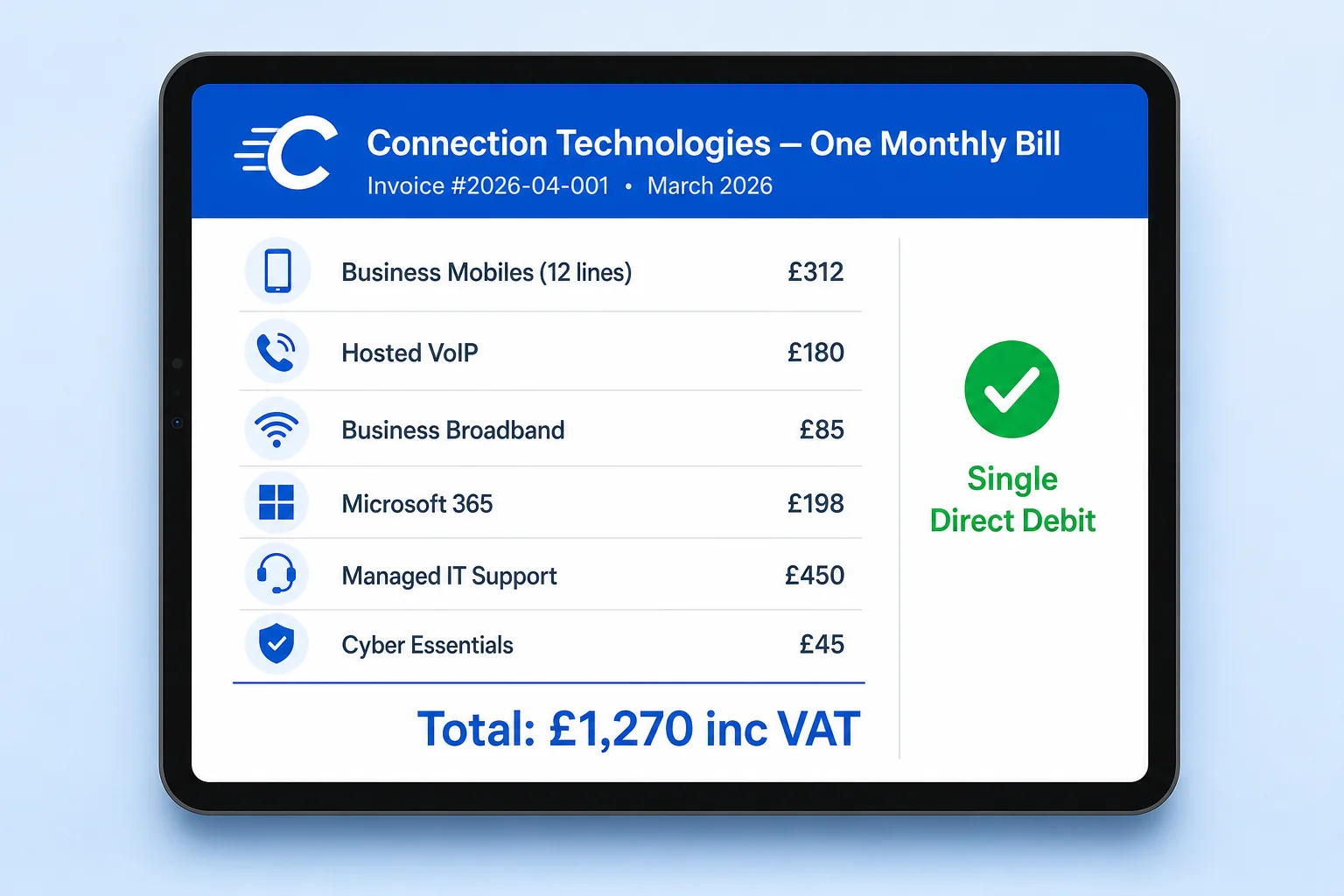
The detail matters. Single contract means co-terminus end dates so you can review your whole tech stack on the same day each year, not in a rolling drip of supplier-by-supplier renewals. Single bill means one PDF, one direct debit and one VAT line for finance to reconcile. Single support team means the engineer who looks after your VoIP system can also see the SD-WAN config, the Microsoft 365 tenant and the cyber posture — so when something goes wrong they can troubleshoot end-to-end without raising tickets with three other companies.
Want a quick comparison? Send us your latest invoices for mobiles, broadband, VoIP, IT support and M365 — we'll show you the consolidated equivalent in one PDF.
Three named bundles, picked to match how SMEs actually work
Bundles only work if they map onto the way you actually run the business. We tried generic "Bronze / Silver / Gold" tiers; they kept missing real-world fits. So we re-shaped the offer around three operating patterns we see again and again.
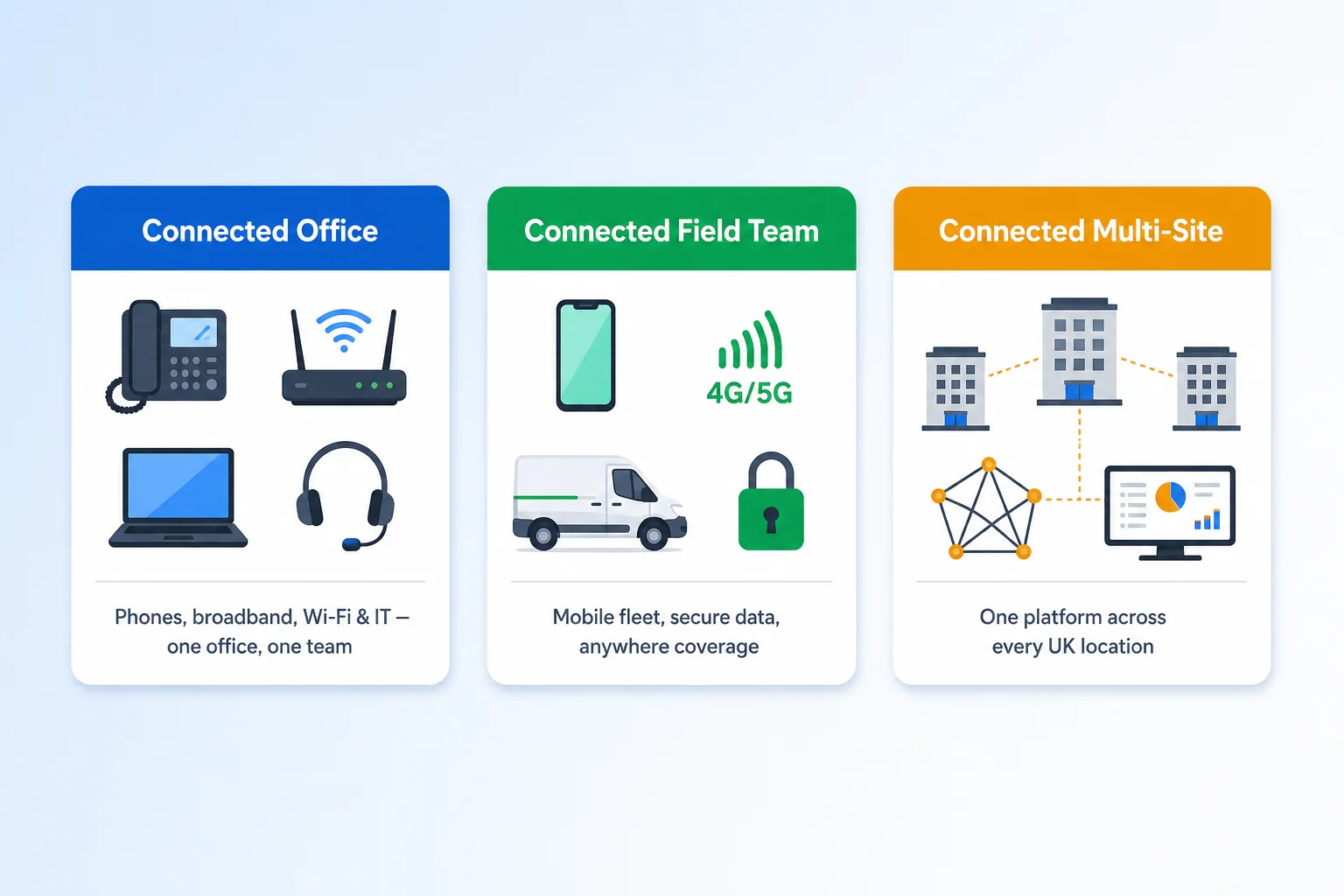
For: desk-based teams of 10–60 in a single UK office.
- Hosted VoIP phones & softphone app
- FTTP / leased-line broadband with SLA
- Managed business Wi-Fi
- Managed IT support & Microsoft 365
- Cyber Essentials certification managed for you
For: mobile-first teams — engineers, drivers, healthcare, sales.
- Business mobile SIMs on the strongest UK network for each postcode
- Pooled data with overage caps
- Mobile device management & remote wipe
- Hosted VoIP softphone for office handover
- Managed detection & response on every device
For: 2–20 UK sites needing one platform, one playbook.
- SD-WAN over FTTP / leased-line per site
- Single hosted VoIP tenant across every location
- Centralised Microsoft 365 + identity
- Site-aware SIEM & SOC monitoring
- One service desk, one ticket queue, one weekly KPI report
Connected Office in detail
Connected Office is the bundle 80% of UK SMEs land on. It's built for a single-site team that does most of its work at desks but wants a softphone for hybrid days, fast managed Wi-Fi for visitors and meeting rooms, and proactive IT support that monitors patches, back-ups and endpoint security without anybody having to chase. We typically deliver it for £35–£75 per user per month all-in, depending on whether you take Microsoft 365 Business Standard or Premium and whether you want Cyber Essentials certification managed end-to-end.
Connected Field Team in detail
Field-based teams have a different problem: their devices walk out of the building every morning and can connect to anything. Connected Field Team starts with the right SIM for the right postcode (we benchmark all four UK networks per location, so we don't put EE SIMs into a Vodafone-strong area), wraps each device in MDM with remote wipe, and adds a softphone so a field engineer can answer the office DDI from their van. The cyber posture is a built-in MDR agent on every phone and laptop — the same posture the Cyber Essentials questionnaire asks for, ready to go.
Connected Multi-Site in detail
Multi-site businesses (think dental groups, charity head office plus branches, regional accountants, distribution depots) hit a specific tipping point: every site grows its own technology stack, and within three years there is no consistency, no leverage and no single dashboard. Connected Multi-Site replaces that with one SD-WAN fabric across sites, one hosted VoIP tenant so call routing between sites is free, one Microsoft 365 identity, and one SIEM/SOC view that knows which site each alert came from. We bill per-site or per-user — your choice — and aggregate to one monthly invoice.
Already running a hybrid setup? We routinely lift-and-shift from BT, Daisy, Onecom and Focus Group with no downtime — we keep your numbers, your handsets and your existing email aliases.
Before / after: what consolidating looks like for a real 25-person SME
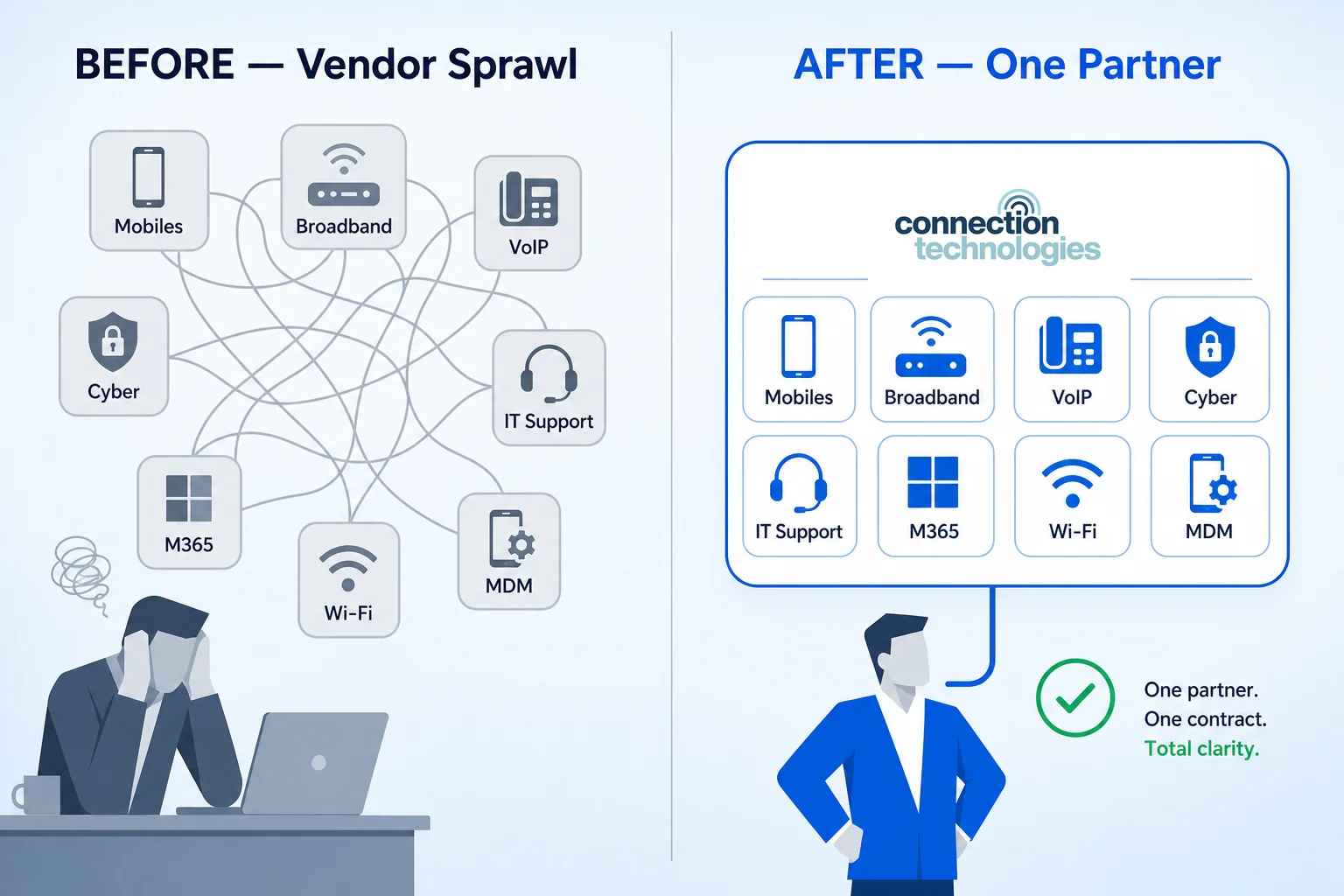
Here is the shape of a typical consolidation, drawn from the kind of "5–10 vendors into one" projects we run every month. Names redacted, numbers averaged from three recent UK SMEs of similar scale.
| Layer | Before (typical SME) | After (Connection Technologies) |
|---|---|---|
| Mobile lines | EE direct, mid-contract | CT business mobile pool, best-network-per-postcode |
| Phone system | Local VoIP reseller, 36-month tie-in | CT Hypercloud Hosted VoIP |
| Broadband | BT Business FTTP | CT business broadband on best-available carrier |
| Wi-Fi | Office manager + Argos router | CT-managed business-grade Wi-Fi |
| IT support | One-person local MSP, ad-hoc | CT managed IT, named UK engineer |
| Microsoft 365 | Sold direct, no admin | CT-managed M365 with security baselines |
| Mobile device mgmt | Not deployed | CT MDM with remote wipe |
| Cyber posture | Antivirus only, no certification | CT-managed Cyber Essentials + MDR |
| Contracts | 8 contracts, 8 end dates | 1 contract, co-terminus |
| Invoices/month | 4–6 | 1 |
| Account managers | 0 named, ~4 helpdesks | 1 named UK AM |
| Typical monthly spend | £4,800 | £3,400 (saving ≈ 29%) |
The headline numbers people remember: eight contracts to one, five invoices to one, and a ~29% reduction in monthly spend. But the side-effects matter as much. The same SME's average ticket-resolution time dropped from 8 hours (multi-vendor) to under 2 hours, simply because one team owned the whole stack.
Connection Technologies vs BT, Daisy, Onecom, Focus Group, Zen
UK SMEs comparing single-provider options usually evaluate Connection Technologies against the same five names. Here is an honest like-for-like at the things that matter for a single-provider decision.
| Criterion | CT | BT | Daisy | Onecom | Focus | Zen |
|---|---|---|---|---|---|---|
| Mobiles + VoIP + Broadband + IT + Cyber on one contract | Yes | Partial | Yes | Partial | Yes | No (no mobiles) |
| Single named UK account manager | Yes | Helpdesks | Tier-dependent | Tier-dependent | Yes | Yes |
| UK-only support team | Yes | Mixed | Mixed | Yes | Yes | Yes |
| RPI-linked annual increases | No | Yes | Yes | Sometimes | Yes | Sometimes |
| Co-terminus contract end dates | Yes | No | If negotiated | If negotiated | Yes | Yes |
| Cyber Essentials managed for you | Yes | No | Add-on | No | Add-on | Add-on |
| Quote turnaround | ≤ 24 hr | 5–10 days | 3–5 days | 2–4 days | ≤ 48 hr | ≤ 48 hr |
Where the trade-offs land is usually predictable: BT wins on brand recognition, Daisy and Focus Group win on national scale, Onecom wins on mobile-first SMEs, Zen wins on broadband-led organic growth. Connection Technologies wins for SMEs between 10 and 250 staff who want a single contract, a named human, no RPI surprises and Cyber Essentials handled inside the bundle. If that's not you, we'll happily tell you so — see our honest "Who we're best for (and who we're not)" page.
A 30-day switching playbook
The single biggest reason SMEs stay with a fragmented stack is the perceived pain of switching. In practice, a phased migration is straightforward. This is the sequence we use:
Days 1–7: discovery and shadow audit
You give us read-only sight of your last three months of invoices and a copy of any current contract end-dates. We map every active service, identify duplications (you'd be surprised), and produce a single consolidated quote with a clear delta vs your current spend. No commitment, no obligation — many SMEs use this stage as a free benchmark even if they end up renewing elsewhere.
Days 8–14: contract co-terminus planning
We schedule the migration around your existing end-dates so you avoid early-termination fees. Mobiles often move first because most networks allow porting at any time; broadband and VoIP typically follow when the regional carrier exit window opens. The plan is one shared Gantt chart you can show the board.
Days 15–25: phased migration
We port mobile numbers, migrate VoIP DDIs (so the office number doesn't change), provision new SIMs, deploy MDM, take over Microsoft 365 admin and stand up the new managed Wi-Fi. Your existing IT contact is briefed (or replaced) and your team gets a one-page "how to log a ticket" guide. There is no big-bang weekend cutover.
Days 26–30: handover & first review
You meet your named UK account manager, get your first consolidated invoice (you can preview it in advance) and sign off the live state. We run a 30-day, 60-day and 90-day review cycle for the first quarter to catch any settling-in issues. After that we move to a quarterly business review with metrics that matter: uptime, ticket resolution times, security posture, and total monthly spend trend.
Want a same-day estimate? Use our calculators and you'll get an instant ballpark before you talk to anyone. Our IT support cost calculator, VoIP cost calculator and telecoms calculator all map cleanly into the bundles above.
Why this matters in 2026 — three tail-winds making consolidation urgent
If you've been "meaning to sort it" for two years, three things have just made the deadline real.
1. The PSTN switch-off (January 2027). Every business still on a traditional analogue or ISDN line has to be on a VoIP platform inside 18 months. That's a forced project — and the smart move is to use it as the trigger to consolidate everything else at the same time. We've documented the full migration in our PSTN switch-off guide.
2. Cyber-insurance underwriting got stricter. Premiums in 2026 are explicitly tied to whether you have Cyber Essentials, MDM on every device, and a single security posture across mobile, M365 and endpoints. Multi-vendor stacks fail those questionnaires more often than not. See our breakdown of UK cyber insurance in 2026.
3. SME margins are tighter. 2026 is a tougher trading year for most UK SMEs. A 15–30% structural saving on the technology stack — without losing capability — is a board-level conversation, not just an IT one. The CFO wants a single forecastable line on the P&L, not six unpredictable ones.
How to know if you're a good fit for a single-partner approach
Be honest about your situation. The single-partner model works best when:
- You have between 10 and 250 staff in the UK.
- You currently use three or more distinct technology suppliers.
- You have nobody internally whose full-time job is "tech vendor management" — and you don't want to hire one.
- You want predictable monthly cost rather than surprise renewals.
- You care about cyber posture and want one team owning it across mobile, laptop and cloud.
If three or more of those describe you, consolidating to a single partner is almost certainly the right move. If you're enterprise-scale (1,000+ staff) with internal teams already managing each layer, a multi-vendor approach may still be the right call — read our honest "Who we're best for" page before you commit either way.
Frequently asked questions
It means one provider that delivers and supports every layer of your business technology stack — mobiles, hosted VoIP, broadband, Wi-Fi, IT support, Microsoft 365, mobile device management, and cyber security — under one contract framework, one monthly invoice and one named account manager. You stop dealing with separate suppliers for each service.
Based on real Connection Technologies migrations of 10–60 user UK SMEs, the typical headline saving is 15–30% on monthly tech spend. The bigger gains, though, are in time saved managing suppliers (4–6 hours/week back) and in faster issue resolution (often a 4× improvement). Use our IT support cost calculator and VoIP cost calculator for a quick ballpark.
No. The whole point of the 30-day switching playbook is a phased migration that respects your existing contract end-dates so you avoid early-termination fees. Mobiles typically port first, broadband and VoIP follow when the carrier exit window opens, and IT support handover happens in parallel. There is no big-bang weekend cutover.
Connected Office is for desk-based teams in a single UK location and bundles VoIP, broadband, Wi-Fi, IT support, M365 and Cyber Essentials. Connected Field Team is for mobile-first teams (engineers, drivers, healthcare, sales) and bundles business mobiles on the best-network-per-postcode, MDM, softphone and MDR cyber. Connected Multi-Site is for businesses across 2–20 UK sites and adds SD-WAN, a single VoIP tenant, central M365 identity and site-aware SOC monitoring. All three are billed as one consolidated monthly invoice.
For UK SMEs of 10–250 staff, the differentiators are: a single named UK account manager (vs helpdesks), no RPI-linked annual price increases, co-terminus contract end-dates, Cyber Essentials managed inside the bundle, and a quote turnaround inside 24 hours. The full table is in the comparison section above. Larger enterprises with internal vendor-management teams may find a multi-vendor approach still suits them — see our "Who we're best for" page for an honest fit check.
That's the most common worry, and the answer depends on the provider. Connection Technologies operates on fair contracts with no punitive lock-in — your prices are fixed for the term, your data stays portable, and you keep ownership of your numbers, M365 tenant and identity. If we lose your trust, you can leave with your stack intact. Bundling doesn't have to mean trapping.
Related Reading
More from the Connection Technologies blog.