

The UK IT & Telecoms Support Promise: Real Humans, Real SLAs, Really Fast (2026)
UK SMEs are tired of phone trees, chatbots and ticket-bouncing offshore tier 1. This is the Connection Technologies Connected Care promise: a real UK helpdesk, named engineers, a 10-minute P1 response target, a strong first-fix focus at tier 1 and 24/7 proactive monitoring — all backed by service standards we publish, not bury.

Key takeaways
- UK SMEs ask the same three questions about IT support: "How fast do you really answer? Are you UK-based? Do you spot problems before I do?" Most providers dodge all three.
- Connected Care publishes the targets we hold ourselves to: a 10-minute first response on P1, a strong first-fix rate at tier 1, customer-led CSAT reviews and 99.9%+ voice uptime as a platform target.
- Every account gets one named UK account manager and one named technical lead — not a rotating pool of ticket-handlers.
- Proactive layer (Connected Care Pulse) is designed to catch issues before users notice, with monitoring, alerting and triage running 24/7. Here's how the monitoring stack works.
Right-fit context: See where the UK Support Promise lands on the Right-Fit Map — from early-stage startup (standard Connected Care) through to mission-critical / regulated (Connected Assurance).
The "support theatre" UK SMEs are stuck in
Talk to ten SME owners about their telecoms or managed IT support and you'll hear the same script. They were promised "24/7", "UK-based", "rapid response" and "proactive monitoring" by every supplier in the running. Six months in, what they actually got was a phone tree, a chatbot, a ticket portal that nobody reads, and a tier-1 agent in a different time zone reading from a script.
That's support theatre. The marketing copy is the same; the experience is wildly different. And UK SMEs are now actively seeking the opposite: fast, human, expert support — UK-based, named, accountable.
Search-intent data backs this up. Queries like "how fast does my IT helpdesk really answer?", "UK-based IT helpdesk no chatbot", "named account manager IT support", and "proactive IT support that spots issues first" have grown sharply since 2024. The buyer is no longer asking if support matters — they're asking which provider can prove it.
Connected Care is our answer to that brief. It is not an upsell. It is not "premium support". It is the only support tier we sell — because we don't think there's a market in 2026 for the alternative. Every Connection Technologies customer, whether they spend £400 a month on a few business mobile lines or £40,000 a month on a multi-site managed IT estate, gets the same SLAs and the same UK humans.
The Connected Care promise (in plain English)
Six commitments, no asterisks. If something slips outside agreed maintenance windows, your named account manager will explain what happened, why, and the changes we’re making to put it right.
1. UK humans only
No chatbot, no offshore tier 1
- Helpdesk staffed by UK-based, UK-employed engineers
- Phone, email, portal & live chat all answered by humans
- Voicemail/IVR only used for after-hours triage routing
- Identity-verified callbacks within agreed SLA
2. 10-minute P1 response
Business hours, with 24/7 on-call cover
- P1 critical: real UK human within 10 minutes, 24/7
- P2 high: 30-minute response target
- Standard query: within 1 business hour (most resolved first contact)
- Updates at clear, agreed intervals through to resolution
3. First-fix at tier 1
High first-fix target across all ticket types
- Tier 1 engineers are senior — no scripts, no escalations for routine issues
- Tier 2 engineering on-call 24/7 for complex tickets
- Vendor escalation paths agreed in advance (Microsoft, Cisco, BT Openreach)
- Quarterly first-fix review shared with each customer
4. Named contacts both ways
One account manager, one technical lead
- Named UK account manager, contactable directly
- Named technical lead who knows your stack inside-out
- Direct mobile numbers for both — not a ticket queue
- Quarterly business reviews with the same two faces
5. Proactive monitoring
Connected Care Pulse, 24/7
- RMM agent on every endpoint, server & network device
- Synthetic checks against critical apps every 60 seconds
- Patch deck managed and reported monthly
- Backups verified weekly with restore tests quarterly
6. Published SLAs & metrics
Clear reporting, every month
- Monthly SLA report sent to every customer (no portal hunt)
- Live status page at status.connection-technologies.co.uk
- If we miss SLA, your account manager owns the explanation and remediation plan
- Annual customer satisfaction survey, results shared back
Why we publish the numbers
Every IT supplier promises "fast" and "proactive". Almost none publish what those words mean. Connected Care commits to specific targets because vague promises don’t help anyone. If we say 10 minutes, that’s the standard we work to — and if we slip, you’ll hear from your account manager with a clear explanation and the change we’re making to prevent it next time.
The numbers we publish
Below are the four targets we lead with on every IT support proposal. They’re reviewed monthly and tied to your contract — if we slip, you get a clear written explanation and a root-cause review, not excuses.
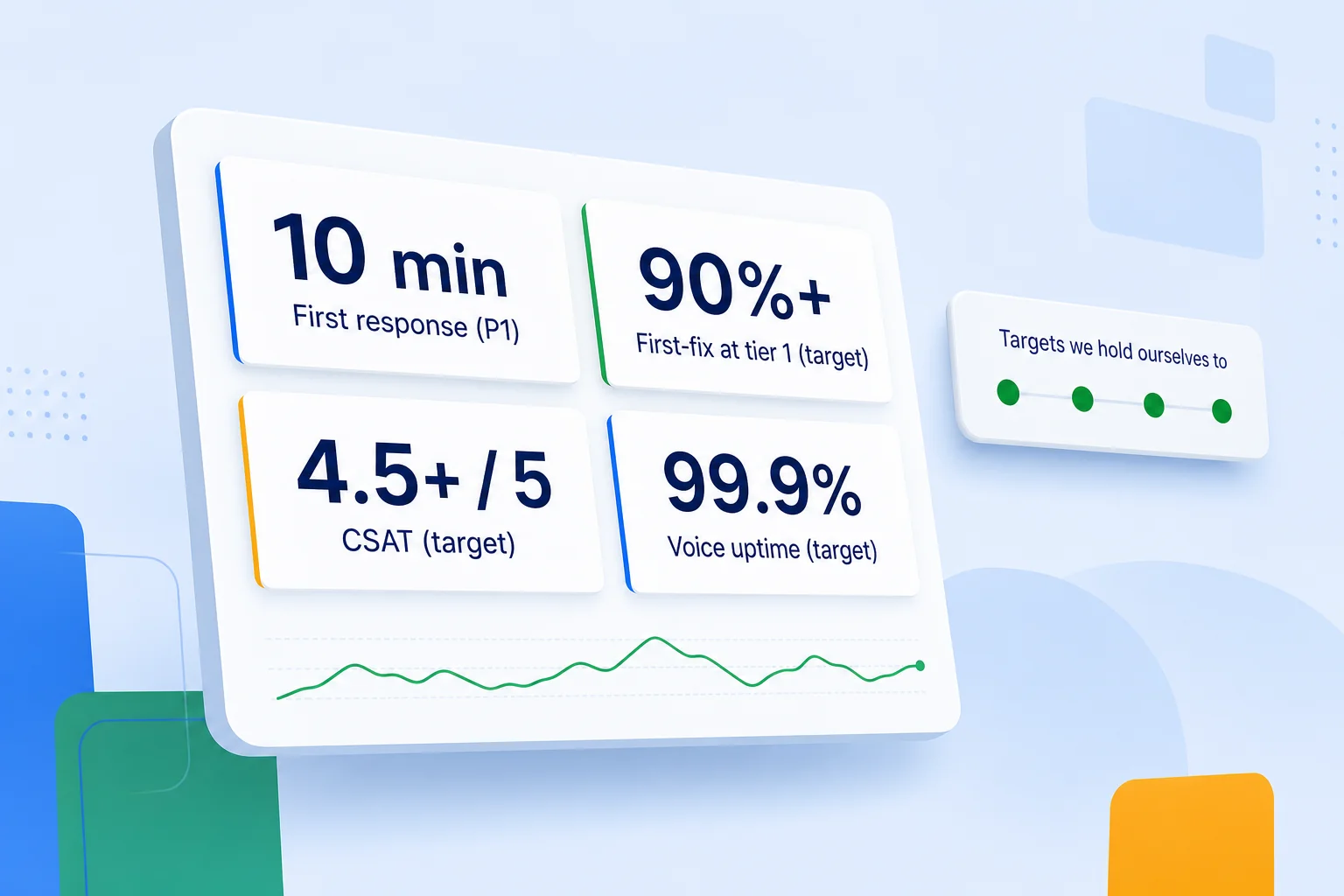
| Metric | Industry norm | Connected Care target | How we measure it |
|---|---|---|---|
| First response time | 10–15 minutes (varies widely) | 10 min (P1), 30 min (P2) | PSA timestamp from ticket open to first human reply |
| First-fix rate at tier 1 | ~58% | High (90%+ aim) | Tickets resolved without escalation, by category |
| Mean time to resolve (MTTR), P2 | ~6 hours | <4 hours | PSA elapsed from ticket open to customer-confirmed close |
| Customer satisfaction (CSAT) | ~3.8/5 | ≥4.5/5 | Per-ticket micro-survey + annual deeper survey |
| Voice platform uptime | ~99.5% | 99.9%+ (platform target) | Carrier & platform monitoring, monthly availability report |
| Broadband uptime (single-carrier) | ~99.7% | 99.9% (single-circuit aim) | Carrier-reported availability + our circuit monitoring |
| Patch compliance (critical CVEs) | ~62% within 14 days | 95% within 14 days | RMM patch report shared with you each quarter |
| Backup restore success | ~74% | Tested every quarter | Quarterly test-restore with documented sign-off |
These targets are reviewed regularly with our operations team and tracked through our PSA, monitoring tooling and customer surveys. Where a target slips, we own the root cause — we don’t hide it in a portal.
A note on “industry norms”
The figures in column two are indicative ranges drawn from publicly-available service-desk benchmarks (MetricNet, Service Desk Institute, HDI). Many "fast support" claims in the market sit at or below these ranges — which is why the gap between marketing copy and lived experience has become a buying issue.
How a real incident is handled
SLAs only matter if there's a runbook behind them. Every Connected Care ticket follows the same five-step flow, with the customer kept informed at every step.
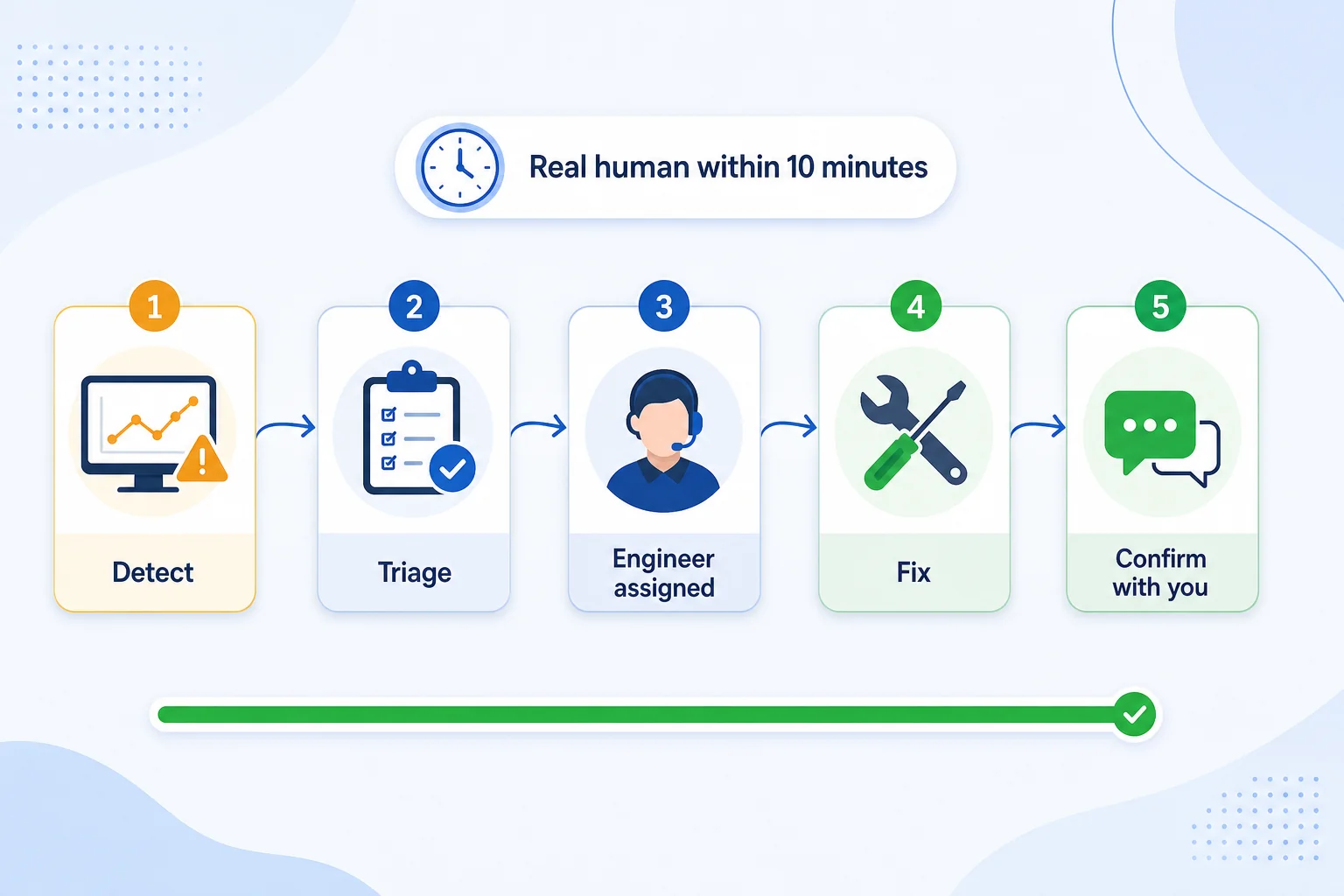
Stage 1 — Detect (you call, or we spot it first)
The ticket starts the moment something happens. Either you ring/email/portal/chat us, or our monitoring stack raises an alert before you've noticed. A meaningful share of P1 incidents on Connected Care customers are opened by us, not the customer — that’s the proactive layer doing its job.
Stage 2 — Triage (within 10 minutes on P1, by a UK human)
A senior UK engineer responds within the SLA window via your chosen channel, identifies you (multi-factor on a P1), classifies the priority and confirms whether we’re fixing now or scheduling. No “I’ll log a ticket and someone will call you back”. The ticket is logged during the conversation, not instead of one.
Stage 3 — Engineer assigned (named, contactable)
For anything that can't be solved in the first 90 seconds, your named technical lead or their assigned deputy is paged. You get their direct mobile, an ETA, and a ticket reference. They own the resolution end-to-end — they don't pass you sideways to a queue.
Stage 4 — Fix (with status updates every 15 minutes for P1)
Engineering work happens with rolling status updates at agreed intervals — frequent for P1, scheduled for P2, and at meaningful milestones otherwise. We text and email proactively; we don’t make you refresh a portal to chase progress.
Stage 5 — Confirm with you (and feed it back)
Closure only happens after you confirm the issue is resolved. We then ask one CSAT question, and any P1/P2 incident triggers a written root-cause summary within 48 hours. Patterns get fed back into the proactive layer so the same issue can't recur.
Proactive layer: Connected Care Pulse
Reactive support — even excellent reactive support — is still a step behind. The best incident is the one the user never notices. Connected Care Pulse is the proactive layer that watches your stack 24/7, alerts our engineers, and (where it’s safe) attempts auto-remediation before users feel an impact.
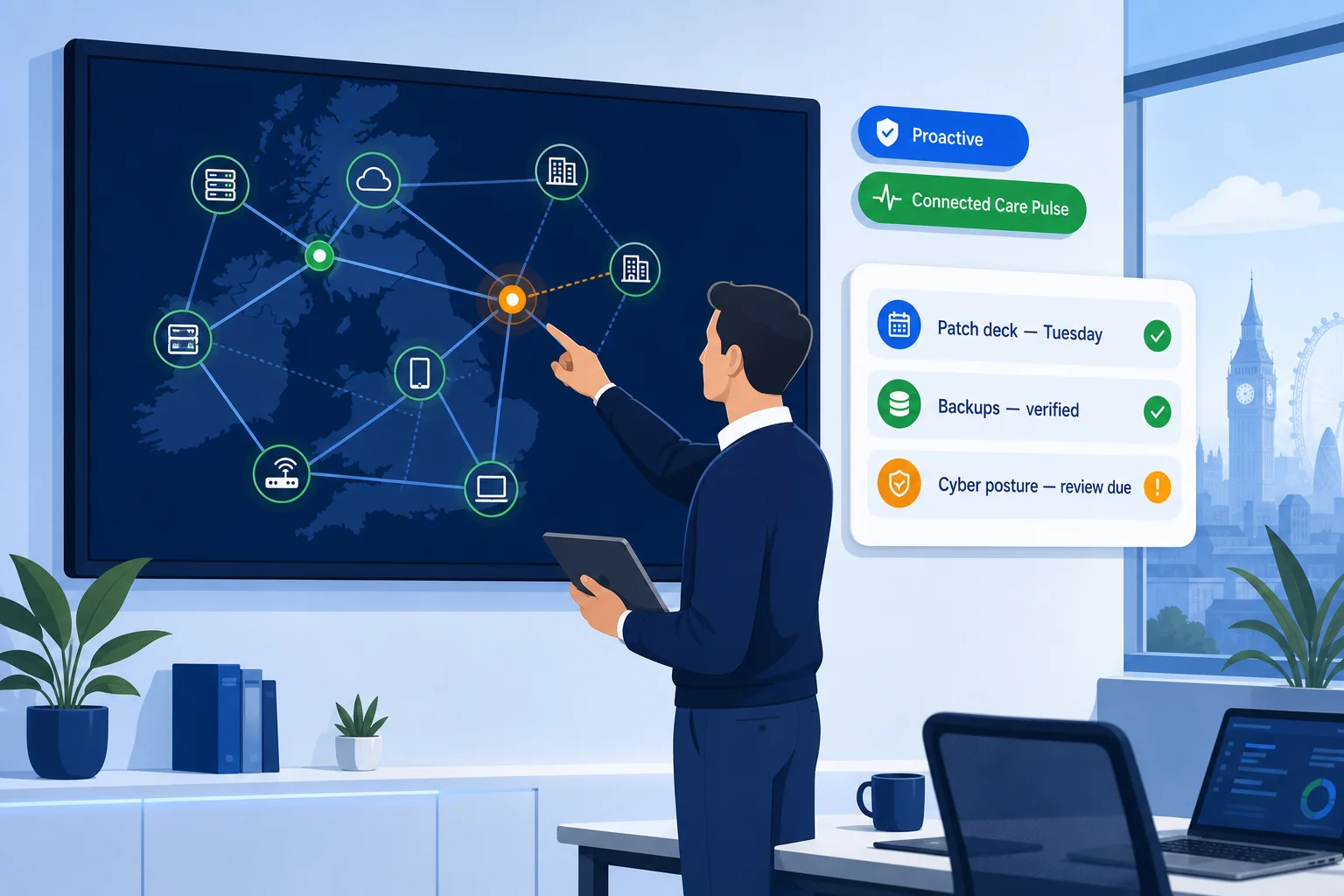
What Pulse covers
- Endpoint & server monitoring — CPU, RAM, disk, services, event log, EDR alerts pushed straight to our PSA.
- Network monitoring — switches, routers, Wi-Fi APs, broadband circuits, SD-WAN tunnels, firewalls.
- Voice monitoring — VoIP trunk health, call quality (MOS scores), one-way audio detection, registration losses.
- Synthetic checks — we run scripted "fake user" transactions against your critical apps every 60 seconds.
- Backup verification — nightly job status, weekly verification job, quarterly restore test (and yes, we tell you if it failed).
- Patch management — rolling patch deck, monthly cadence, emergency CVE patching within 72 hours.
- Cyber posture — integrated with our Cyber Essentials-aligned baseline and managed detection & response.
Quarterly IT & cost reviews
Pulse also includes scheduled, written IT health checks every quarter. Your named account manager walks you through:
- Ticket trend analysis — what broke, why, and what's been fixed at the root
- Patch & CVE compliance position vs your contractual baseline
- Asset register reconciliation (so we never bill for kit that left the building)
- Spend review — mobile, voice, broadband, M365 licensing — and where to consolidate or trim
- Roadmap items: PSTN switch-off readiness (January 2027), Windows 10 ESU expiry (13 October 2026), MFA rollouts, etc.
Why proactive matters
Across our ticket data, Connected Care Pulse regularly opens P2 incidents before users notice them, and a meaningful share of those are remediated before there’s any user impact. That’s the proactive promise — not “we’ll get to it eventually”, but “we’ll have eyes on it before you call.”
Connected Care vs big-telco vs local IT firm
UK SMEs typically choose between three support models. Here's how they actually compare on the things that matter day-to-day.
| Capability | Big telco / network | Local one-person MSP | Connected Care |
|---|---|---|---|
| UK-based humans on first contact | Some, often offshore tier 1 | Yes (one person) | Yes, full UK team |
| First response on P1 | Often 15–30 min, phone-tree first | Depends on availability | 10-minute SLA, contractually committed |
| Named account manager | Pooled inbox | Yes (also the engineer) | Yes, separate from engineer |
| Named technical lead | No | Same person doing everything | Yes, dedicated |
| 24/7 coverage with senior on-call | 24/7 but mostly tier 1 | No | Yes, senior engineer always on-call |
| Proactive monitoring & alerts | Network only, no endpoints | Limited tooling | Full stack via Pulse |
| Published SLAs with monthly reporting | Buried in MSAs; minimal reporting | Often informal | Yes, plain-English monthly report |
| Quarterly IT & cost reviews | Account "check-in" once a year | Ad-hoc | Yes, written quarterly |
| Frustration when you escalate | High — classic complaint | Low if they're available | Low — named lead owns it |
| Single accountable supplier | For their own service only | For IT only, not telecoms | Yes — one partner for IT & telecoms |
The big-telco model wins on geographic scale and the local-MSP model wins on personal relationship — but neither wins on both human accountability and operational depth. That's the gap Connected Care is built to fill.
What's included as standard (no surprise bills)
One of the most-asked questions on sales calls is "what's an extra-charge?". Here's the honest list. If it's not on the "extras" line, it's included — even on entry-level contracts.
Always included
- UK helpdesk: phone, email, portal, live chat (all answered by UK humans)
- 24/7 monitoring on all in-scope endpoints, servers, network and voice
- Patch management, anti-virus / EDR, basic backup management
- Named UK account manager + named technical lead
- Quarterly written IT & cost review
- Monthly SLA report (delivered, not buried in a portal)
- Vendor escalation handling (Microsoft, Cisco, BT Openreach, mobile carriers)
- Onboarding documentation (network diagrams, asset register, runbooks) maintained for you
- Plain-English explanation and root-cause review when we miss SLA
Charged separately (and quoted upfront)
- Project work outside the agreed steady-state scope (office moves, M365 tenant migrations, full firewall rebuilds, PSTN switch-off cutovers)
- On-site engineer attendance (one site visit/quarter is included on Connected Care Plus)
- Hardware (laptops, phones, switches, APs) supplied at cost-plus-handling
- Third-party licensing (Microsoft 365, Adobe, vendor SaaS)
- Out-of-scope incidents (e.g. cyber breaches outside the agreed posture — covered if you're on our MDR tier)
No “best-case only” claims
If a Connected Care commitment can only be hit on a “best day”, we don’t list it. The targets on this page are the standards we hold ourselves to day-in, day-out — not a marketing ceiling. We’d rather under-promise on the brochure than under-deliver on the renewal.
Frequently asked questions
Is your IT support helpdesk really UK-based, or just routed through the UK?
Every Connected Care helpdesk engineer is UK-based, UK-employed and physically working from one of our UK locations. Calls are not routed offshore for tier-1 triage. Out-of-hours coverage is provided by senior UK engineers on rotating on-call — not an outsourced overseas team.
You can ask any engineer "where are you sitting right now?" on any call and the answer will be a UK city.
What does the 10-minute response time actually mean?
It means a real UK engineer responds to your P1 priority ticket within 10 minutes, in business hours, with 24/7 senior on-call cover for genuine emergencies. P2 high-priority tickets carry a 30-minute response target; standard queries are typically picked up within an hour.
If we miss an SLA outside agreed maintenance windows, your account manager will share what happened, why, and what changes we’re making to prevent it next time. We don’t hide service issues behind a portal.
What's the difference between Connected Care and Connected Care Pulse?
Connected Care is the support promise — the SLAs, named contacts, UK helpdesk and escalation paths described above. It's included with every Connection Technologies contract.
Connected Care Pulse is the proactive monitoring & managed-services layer on top: 24/7 endpoint and network monitoring, patch management, backup verification, synthetic checks and quarterly IT health reviews. Pulse is included as standard on all managed IT contracts and is available as an add-on for telecoms-only customers.
Do I get a named account manager and a named technical lead?
Yes — both, named, contactable on direct mobile. Your account manager owns commercial, contract, billing and roadmap conversations. Your technical lead owns the engineering side: knows your network, your asset register, your apps and your previous incidents.
The two roles are separate on purpose. The classic "one-person MSP" model means a single person covers both — which is fine until they go on leave or you scale. Read more on why we split them.
How does Connected Care compare to a big-telco SLA?
Big-telco SLAs are typically narrower (only network/voice uptime, often excluding “third-party caused” outages), require you to formally claim anything, and are answered through pooled tier-1 helpdesks where the first agent doesn’t know your account. Connected Care covers the full stack (endpoints, network, voice, cyber posture), routes you to a senior UK engineer who already knows your setup, and reports against its targets every month in plain English.
What happens if my office has a major outage out of hours?
Out-of-hours P1 incidents go straight to a senior on-call UK engineer with the same 10-minute response SLA. We hold pre-agreed escalation contacts for your business (so we know who to wake up and who not to), pre-staged backup connectivity options where applicable (4G/5G failover routers, second carrier broadband), and a written incident-response runbook for major events like a building power cut, a fibre dig, or a ransomware indicator.
For VoIP, we can fail you over to mobile-twinning or alternate sites within minutes. For broadband, we can swap to a backup circuit or provision a 4G failover.
Do you charge extra for emergencies, weekends or office moves?
Emergencies and weekend incident response are included in Connected Care — we don't bill premium rates for solving a fault we've committed to fixing. Planned project work like an office move, a major VoIP cutover, a tenant migration or a security uplift is scoped and quoted separately, with a fixed price agreed before work starts.
Can I see your live SLA performance before signing?
Yes. We share the last 90 days of anonymised metrics during the proposal stage and walk new customers through their first monthly SLA report on day 30. The status page at status.connection-technologies.co.uk is live and public.
Hosted Voice
Cloud phone systems with UK support, transparent pricing and no mid-contract price rises.
Get a VoIP QuoteBusiness Mobiles
Every UK network compared for your team size and postcode — quote back within 2 hours.
Get a Mobile QuoteRelated Reading
More from the Connection Technologies blog.