

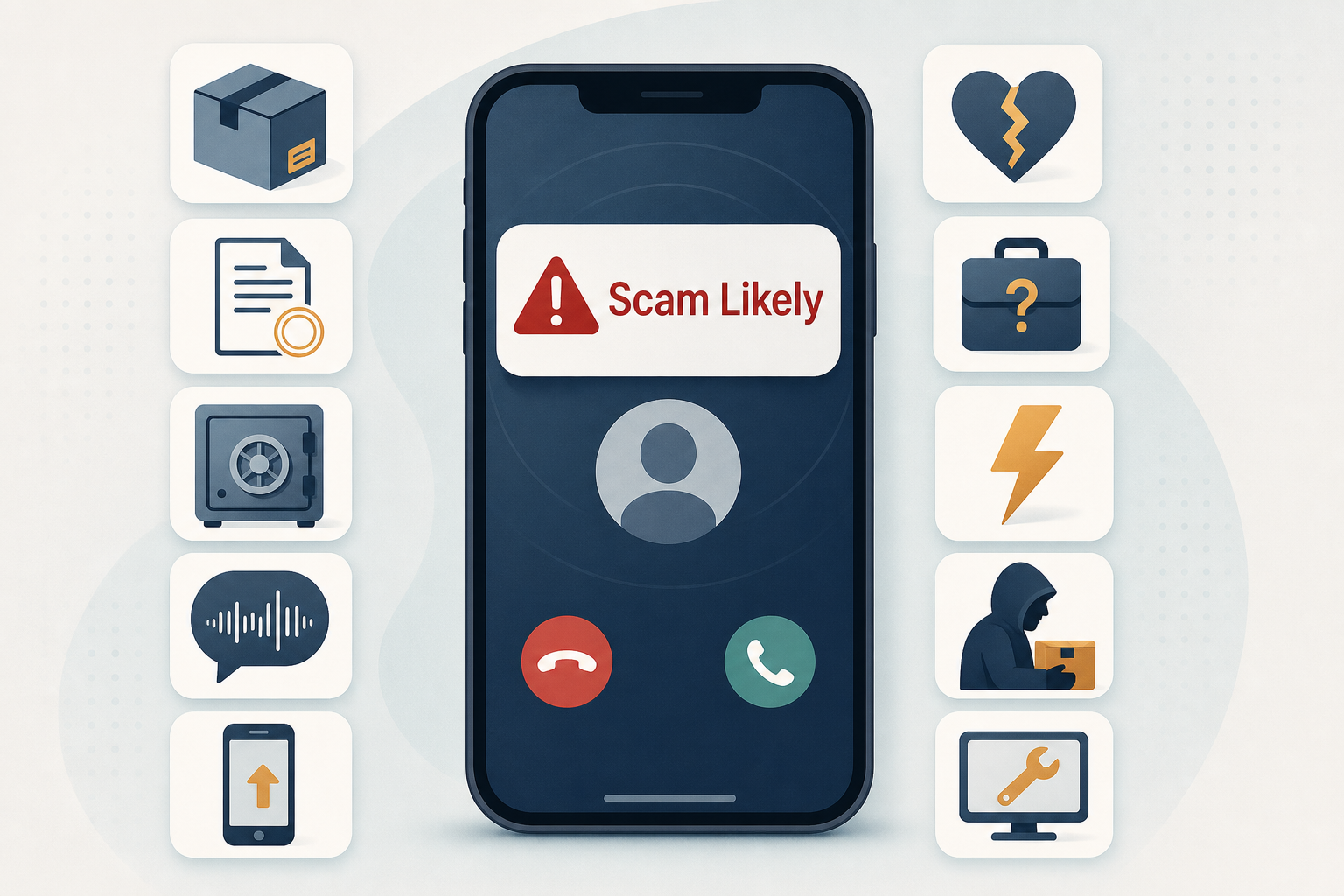
UK phone scams 2026 look very different to the clumsy “Nigerian prince” calls of a decade ago. Scammers now use spoofed caller IDs, AI-cloned voices, professionally written SMS templates and call-centre scripts that can fool even cautious people. This guide walks through the ten most common scam types being reported to Action Fraud and UK mobile networks right now, the exact warning signs to listen for, and what to do if you’ve already engaged with the caller. For any unknown caller, the safest first step is to run the number through our free UK phone number checker before you call back.
The 2026 UK Phone Scam Landscape
Phone fraud remains the single biggest channel for adult financial scams in the UK. Action Fraud receives more reports about phone-initiated fraud than email, social media and door-to-door combined. Ofcom’s most recent Scams Tracker shows that around four in five UK adults received a suspected scam call or text in the previous three months, with people aged 75 and over disproportionately targeted by impersonation scams.
Three things have shifted in 2026. First, scammers now use number spoofing as standard, so the caller ID you see is almost never the real source. Second, generative AI has made voice cloning and conversational scripting cheap and convincing. Third, mobile networks have rolled out network-level scam filtering, which has pushed criminals toward newer formats like fake job offers on WhatsApp and “AI voice” emergencies on landlines.
If a number looks suspicious, you can check whether other people have already reported it on our most reported scam numbers right now page, or browse the full reverse phone lookup directory for a specific prefix. For carrier-specific patterns, we maintain dedicated pages for the most-reported numbers from O2-allocated ranges and the most-reported BT-range numbers.
Scam #1: Parcel-Delivery and “Missed Delivery” SMS-to-Call
This is the most reported UK phone scam of 2026 by raw volume. It almost always begins as a text rather than a call. The SMS pretends to be from Royal Mail, Evri, DPD, Yodel or Amazon Logistics and claims a parcel could not be delivered because the address is incomplete or because a “£1.45 customs fee” is unpaid.
The link in the SMS goes to a clone of the real courier’s site. After harvesting card details, the next stage is a phone call from a “fraud prevention team” telling you that your card has been used and you need to move money to a “safe account” — that callback is the actual money-loss stage of the scam.
Warning Signs
- SMS sender is a UK mobile number (Royal Mail and Evri never text from a personal mobile)
- Domain in the link is not the courier’s real domain (look for hyphens, .top, .xyz, .co rather than .co.uk)
- Request for a tiny but specific fee — £1.45, £2.99, £3.50
- Follow-up call within 48 hours from a “fraud team”
What to Do
Do not tap the link. Forward the text to 7726 (the spam-text reporting shortcode that works on all UK mobile networks) and then delete it. If you have already tapped the link and entered card details, call your bank using the number on the back of your card, not any number the caller gave you.
Scam #2: HMRC, DWP and Action Fraud Impersonation
These calls usually open with an automated message claiming there is a warrant for your arrest over an “unpaid tax bill,” that your National Insurance number has been compromised, or that the police are investigating fraud committed in your name. Pressing “1” connects you to a person posing as an HMRC officer, DWP fraud investigator or Action Fraud agent.
HMRC has been very clear: it will never threaten arrest over the phone, never ask for payment by gift card or bank transfer, and never call from a withheld number (No Caller ID) or 0800 number to demand immediate payment. The DWP does not phone people about benefit fraud in this way. Action Fraud takes reports — it does not phone victims to demand money.
Warning Signs
- Pre-recorded “press 1” opening message
- Caller ID showing a generic 0300 or 0800 number, but the script feels rushed
- Demands for payment in vouchers, cryptocurrency or bank transfer
- Threats of arrest, court action or deportation within hours
What to Do
Hang up immediately. To verify, go to gov.uk and use the contact details published there — never trust a callback number given by the caller. We have a fuller guide on is that 0800 number genuine? covering 0800 impersonation in particular, because most HMRC-style scams now use spoofed 0800 caller IDs to feel official.
Scam #3: Bank “Fraud Team” Callback with Number Spoofing
The fraud team scam is the highest-value scam in the UK by money lost per victim. The caller claims to be from your bank’s fraud team and tells you that suspicious transactions are being attempted on your account right now. To make it feel real, the caller ID on your phone displays the exact number printed on the back of your bank card — because they have spoofed it.
You are walked through “moving” your money to a “safe holding account,” sometimes over several phone calls and several days. The “safe account” is controlled by the scammer. The Authorised Push Payment (APP) fraud category alone costs UK consumers around half a billion pounds a year.
Warning Signs
- Caller knows your name, address and the last four digits of a card — none of which is secret
- Urgency: “we have to act in the next ten minutes or you’ll lose everything”
- Request to download remote-access software (TeamViewer, AnyDesk)
- Request to move money to a “safe account” — banks NEVER do this
- You are told not to discuss the call with anyone, including bank staff in branch
What to Do
Hang up. Wait at least five minutes (scammers can hold the line open after you “hang up” on a landline). Then call your bank from a different phone, or use the in-app chat. If you have already moved money, contact your bank immediately — under the 2024 PSR reimbursement rules, banks must in most cases refund APP fraud up to £85,000.
Scam #4: AI Voice Clone — “Mum, My Phone Is Broken, Send Money”
This is the most distressing new scam of the year. A parent or grandparent receives a call or WhatsApp voice note that sounds exactly like their adult child saying “Mum, I’ve broken my phone, I’m using a friend’s. I’m in trouble — can you transfer me some money?” The voice is generated from 10–30 seconds of public social media audio.
The follow-up is usually a bank transfer request to an “emergency” account, often dressed up as a deposit for a solicitor, a hospital, or a stranded-abroad scenario. We have seen losses of £5,000–£40,000 in single cases reported in 2026.
Warning Signs
- The “child” is calling from an unknown number, often a UK mobile that you don’t recognise
- They claim their phone is broken or lost — so you can’t call back on their real number
- They refuse to do a video call or send a selfie
- They ask for money to be sent to an account name you don’t recognise
What to Do
Agree a family “safe word” in advance with each adult relative and ask for it on any call that involves money. Hang up and call the person on the number you already have saved for them. If you can’t reach them, ask another family member to confirm. Voice cloning is now too good to rely on “it sounded like them.”
Scam #5: Fake Recruiter / Job Offer
Job scams have exploded since 2024 because they bypass network-level call filtering — they start in your text inbox, on WhatsApp, on LinkedIn or on Telegram. A “recruiter” offers easy remote work paying £200–£400 a day for “rating products” or “completing tasks.” The phone call comes later to “verify” you and walk you through the platform.
The platform is real-looking. You earn fake commissions on small tasks. Then a “VIP task” requires you to deposit your own money in crypto to unlock a bigger payout. Once you deposit, the funds are gone and a “supervisor” pushes you to deposit more to “unlock” what you’ve already paid in.
Warning Signs
- Initial contact via WhatsApp, Telegram or random SMS — never a recognised job board
- Company name vague or impossible to find on Companies House
- You are asked to deposit your own money to unlock earnings
- Pay rate too high for the described work (£40/hour for “rating videos”)
What to Do
Block the number, report the WhatsApp account inside WhatsApp, and report to Action Fraud. If you’ve sent crypto, report to your exchange immediately — some can freeze outgoing transactions if reported within minutes.
Scam #6: Energy Refund and Smart-Meter Installation
“Hello, this is the Energy Refund Department. Our records show you are owed £384 from your previous supplier. We just need your bank details to process the refund.” There is no “Energy Refund Department.” Ofgem does not phone customers about refunds.
A related variant offers to book a smart-meter installation with a small “engineer call-out deposit” — the deposit goes to the scammer and no engineer ever arrives. Both rely on the fact that genuine refunds and smart-meter rollouts are real things people are expecting.
Warning Signs
- Caller claims to represent “all suppliers” or a vague “energy ombudsman”
- You’re asked for full account number and sort code to “process the refund”
- You’re asked to pay a small deposit for an installation
- Caller can’t tell you who your current supplier is — but you have to confirm it
What to Do
Hang up. If you think you might genuinely be owed money, log into your energy supplier’s app or website directly. Real refunds are processed back to the payment method on file — they never require you to phone in your bank details.
Scam #7: Tech-Support Remote-Access (Microsoft, Apple, BT Impersonation)
“We’ve detected a virus on your computer.” The caller claims to be from Microsoft, Apple support, BT’s broadband team, or your antivirus provider. They walk you to a website, get you to install a remote-access tool (AnyDesk, TeamViewer, UltraViewer), and then either install malware, lock you out for ransom, or sit silent on the connection while you log into your bank.
The most damaging version of this scam combines remote access with the bank fraud team script (Scam #3). They watch you log in, capture your details, then “help” you move money to safety.
Warning Signs
- Unsolicited call about a computer or broadband problem you didn’t report
- Pressure to “fix it now or your computer will be permanently damaged”
- Any request to install software you’ve never heard of
- Caller wants to “show you” the virus by opening Windows Event Viewer (the warnings there are normal)
What to Do
Hang up. If you’ve installed a remote-access tool, uninstall it, run a malware scan, and change passwords for every account you’ve logged into since (use a different device). If you used your card or banking app on that computer, call your bank.
Scam #8: Wangiri “One-Ring” Premium Callback
Your phone rings once and stops. You see a missed call from an unfamiliar international number, often beginning +355 (Albania), +216 (Tunisia), +213 (Algeria) or +234 (Nigeria). Curiosity makes you call back. The number is a premium-rate international line that connects to a long automated message and charges your account several pounds per minute.
The Japanese word wangiri literally means “one ring and cut.” Scammers run autodialers that drop a single ring across millions of UK numbers per day. Even a 1% callback rate is profitable.
Warning Signs
- Missed call from an international number you don’t recognise
- Number you don’t recognise rings once and never appears as a voicemail
- Multiple friends or colleagues have received the same number
What to Do
Do not call back. If you don’t normally do international business, ask your mobile network to bar premium-rate and international outgoing calls. If you’ve already called back, check your bill — your network may be able to dispute premium charges if reported quickly. You can also cross-check unknown UK callers (like this 020 example in the London range) before deciding whether to ring back.
Scam #9: Romance / “Pig-Butchering” Investment Scams
This scam usually begins on a dating app or via a “wrong number” WhatsApp message that escalates into a friendly chat. Over weeks, the conversation moves to a phone or video call (sometimes using AI-faked video). The scammer builds a relationship, then introduces a “great” crypto investment opportunity on a slick-looking platform.
The platform shows fake gains. Withdrawing requires a “tax” deposit, then a “fee” deposit, then a “compliance” deposit. By the time the victim realises, often six figures are gone. The industry calls it pig butchering because the victim is “fattened” with emotional investment before the slaughter.
Warning Signs
- Online friend you’ve never met in person introduces an investment platform
- Initial small “test” deposits really do produce withdrawable returns (to build trust)
- Bigger withdrawals are blocked until “tax” or “fees” are paid
- Platform isn’t on the FCA register
What to Do
Stop sending money immediately. Report to Action Fraud and to the platform you met on. Tell at least one trusted family member or friend, even if it feels embarrassing — this scam is engineered to keep victims isolated.
Scam #10: Courier / “Your Card Was Used At…” Bank Impersonation
An SMS or call says your debit card has just been used for an unusual purchase — typically a high-value item at Argos, Currys, John Lewis or an Apple Store. To “cancel the transaction,” a courier will be dispatched to collect the card for the bank. The “courier” arrives at your door, takes your card, and uses it within minutes.
Variations include collecting cash, gold, or jewellery to “hold safely.” No real UK bank — HSBC, Barclays, NatWest, Lloyds, Halifax, Nationwide, Santander, Monzo, Starling — sends couriers to collect cards, cash or valuables. Ever.
Warning Signs
- You are told a courier is on the way to collect your bank card
- Caller asks you to cut your card “but only the chip” (the magnetic stripe and PAN still work)
- Caller asks you to withdraw cash for “evidence” or “safekeeping”
- You’re told not to discuss the call with anyone, including bank staff
What to Do
Hang up, do not open the door to anyone, and call 999 if a courier is en route. Report to your bank using the number on your card. If you’ve already handed over a card, freeze it in your banking app (most allow this instantly), then call the bank.
Who Scammers Target Most in 2026
Scammers do not pick numbers at random. Autodialer software cross-references publicly leaked databases, marketing lists, social media scraping and breached telecoms data to build target lists ranked by likelihood of payout.
Three groups are disproportionately hit. People aged 65+ receive far more impersonation and “fraud team” calls because age correlates with home ownership, settled savings and landlines. Anyone who has recently opened a high-street bank account, taken a new mobile contract or moved house generates a fresh data trail that scammers buy from leaked-data resellers. And anyone running a small business with a public website is a target for fake-invoice, fake-supplier and CEO-impersonation scams that combine email with a follow-up phone call.
Recent breaches feed the cycle: every time a UK retailer, telco or NHS supplier leaks customer records, those records show up on scam-dialer target lists within weeks. If you have ever received a “your data was part of a breach” notice, expect a six- to twelve-month spike in suspicious calls.
What Makes a Caller a Higher-Risk Target
- Recently moved address (your land registry record is public)
- Recently opened a business or filed accounts at Companies House
- Listed on a leaked customer database (check haveibeenpwned.com)
- Active on Facebook Marketplace, Gumtree or Vinted (scammers harvest “wrong number” leads from listings)
- Older landline owner with a published number in old paper directories
How to Harden Your Phone Against Scams
You cannot stop scammers calling, but you can make them far less successful when they do. A few changes take fifteen minutes and remove most of the risk.
- Turn on silence-unknown-callers: iPhone Settings → Apps → Phone → Silence Unknown Callers, or Android Phone app → Settings → Caller ID & spam → Filter spam calls. Anyone not in your contacts goes straight to voicemail.
- Register with the Telephone Preference Service: Free at tpsonline.org.uk. Doesn’t stop scammers (they ignore it) but cuts legitimate cold marketing dramatically.
- Bar premium-rate and international calls: Ask your mobile network to add an outgoing bar on 09 and international ranges. Stops Wangiri losses entirely.
- Enable in-app card freeze: Every major UK bank app — Monzo, Starling, Halifax, Lloyds, HSBC, Barclays, Nationwide, NatWest, Santander, First Direct, Revolut — has an instant card freeze. Learn where it is before you need it.
- Agree a family safe word: One short word, never shared online, asked for on any phone call that mentions money. Single best defence against AI voice cloning.
- Use a password manager: Removes the temptation to reuse passwords that scammers can buy from breach dumps. Bitwarden and 1Password both offer free or low-cost UK tiers.
- Block international SMS-senders if you don’t travel: Many smishing campaigns originate from short-leased international SMS gateways.
- Look up unknown UK callers before ringing back: Use our free UK phone number checker or the most-searched UK numbers aggregation page to see if the number has already been reported.
Common Warning Signs Across UK Phone Scams 2026
Almost every UK phone scam in 2026 shares a small number of psychological levers. Recognising the pattern is more useful than memorising every individual script.
- Urgency: “If you don’t act in the next ten minutes you’ll lose access to your account / be arrested / miss the refund window.”
- Authority: The caller claims to represent HMRC, a bank, the police, Microsoft, Ofcom or the courts.
- Isolation: “Don’t tell anyone about this call.” Real organisations never ask for secrecy.
- Unusual payment method: Gift cards, cryptocurrency, bank transfers to unknown accounts, couriered cash.
- Verification by them, not by you: They quote details they shouldn’t have, but refuse to be verified through official channels.
- Caller-ID lookalikes: A spoofed 0800, a number “just one digit off” your bank’s, or your own number calling itself.
If you’re unsure about a specific number, look it up before calling back. Our free UK phone number checker shows reports, area code, network range and risk score for any UK number, and the reverse phone lookup directory covers every UK numbering range. For freephone-prefixed calls, the rules of thumb in our 0800 freephone numbers explained guide are still useful for telling a real corporate 0800 from a scammer’s spoofed one.
How UK Mobile Networks Auto-Filter Scam Calls in 2026
Every major UK network now runs network-level scam filtering on inbound calls and texts. The exact branding and behaviour differ, but the building blocks are the same: a real-time reputation score per number, machine-learning on call patterns (very short calls, very high volume per hour, mismatched origin and caller ID), and consumer complaints fed in via 7726.
On iPhone, scam-flagged calls usually show a “Spam Likely” or “Scam Likely” label above the caller ID — for the technical mechanism, see our dedicated piece on why iPhone shows ‘Spam Likely’. On Android, Google’s own Call Screen sits alongside the network filter and can answer for you and read out the caller’s stated reason for calling.
For businesses, this filtering is a double-edged sword: legitimate cold outreach is increasingly flagged as spam if the calling pattern looks like a call centre. The safe path is to use static, validated outbound CLI, register the number with the network’s “trusted business” lists, and consider mobile number masking and GDPR for any outreach that uses personal mobiles.
How to Report Scam Calls in the UK
Reporting is the single most useful thing you can do. Each report feeds into network filters and Action Fraud’s national pattern analysis — within hours, the same number is blocked across more networks.
- 7726 (free SMS): Forward any suspicious text to 7726 (which spells SPAM on a keypad). Works on EE, Vodafone, O2, Three, Sky Mobile, BT Mobile, Tesco Mobile, giffgaff and all major MVNOs. For texts, just forward the message. For voice calls, send a text to 7726 saying “Call” and the network will reply asking for the number.
- Action Fraud: Report online at actionfraud.police.uk or call 0300 123 2040 (Monday to Friday, 8am to 8pm). This is the official UK route for reporting fraud and cybercrime.
- Your bank: If money has moved, call your bank using the number on your card. Under PSR rules from October 2024, most APP fraud is reimbursed up to £85,000 within five business days.
- Ofcom: Report nuisance calls and silent calls at ofcom.org.uk. Ofcom doesn’t investigate individual cases but uses reports to enforce against UK-based offenders.
- The Information Commissioner’s Office (ICO): Report unsolicited marketing calls at ico.org.uk if you’re registered with the Telephone Preference Service (TPS).
- Police 999: If you believe you are in immediate danger — for example a courier is on the way to your door.
You can also help the wider community by adding the scammer’s number to the public reports on our most reported scam numbers page. Every additional report makes the next victim’s filter slightly more accurate.
Related Guides
- is that 0800 number genuine?
- why iPhone shows ‘Spam Likely’
- mobile number masking and GDPR
- 0800 freephone numbers explained
- free UK phone number checker
Frequently Asked Questions
Forward suspicious texts to 7726 (free on every UK network) and report scam calls to Action Fraud at actionfraud.police.uk or on 0300 123 2040. If money has been taken, call your bank using the number on the back of your card immediately, and freeze the card in your banking app while you wait.
Yes. Caller-ID spoofing lets scammers display almost any number, including your own. If you see your own number calling you it is always a scam — never the network. The same is true of “neighbour spoofing,” where the caller ID matches your area code and the first few digits of your own number to make the call look local.
7726 (which spells SPAM on a keypad) is the free UK-wide shortcode for reporting suspected scam texts and calls to your mobile network. Forward the SMS, or send a text saying “Call” if it was a voice call — the network replies asking for the number. EE, Vodafone, O2, Three, Sky Mobile, BT Mobile, Tesco Mobile, giffgaff and all major MVNOs accept it.
To a large extent, yes. Every major UK network runs network-level scam filtering that blocks the most-reported numbers before the call reaches your phone, and labels suspicious survivors as “Spam Likely” or similar. It is not perfect — newer scam numbers and international Wangiri callbacks still get through, which is why reporting via 7726 matters.
Yes, and they are the fastest-growing scam category in 2026. AI voice clones built from social-media audio are used in “Mum, my phone is broken” emergency-money requests, in fake bank fraud-team calls and even in fake video calls for romance investment scams. Agree a family safe word and always call the person back on the number you already have saved for them.
Call your bank immediately using the number on the back of your card and freeze any affected cards in your banking app. Change passwords for any account you logged into on a compromised device, and report the incident to Action Fraud on 0300 123 2040. Under the 2024 PSR reimbursement rules, most authorised push payment fraud is reimbursed by UK banks up to £85,000 within five business days.
Related Reading
More from the Connection Technologies blog.