

Updated August 2026
Speed data, coverage figures and pricing verified against Ofcom Connected Nations Spring 2026, Opensignal January 2026 report (the most recent UK Mobile Network Experience report) and current operator tariffs. All pricing excludes VAT unless stated otherwise.
How many handsets does your team need?
Get a free no-obligation quote in 60 seconds
When does your current contract expire?
Tell us about your business
Your details
We'll never share your details. Unsubscribe anytime.
Thank you!
One of our mobile experts will be in touch shortly with your tailored quote.















UK best mobile network 2026 — quick reference
In 2026, EE leads UK mobile networks overall — 11 of Opensignal’s 15 awards, the fastest overall download speed (53.2 Mbps) and the UK’s best 5G availability (users connected to 5G 77.4% of the time). Three has the UK’s fastest 5G (187 Mbps average), the largest 5G town footprint (370+ towns) and the cheapest business SIM-only tariff (from £20/month). Vodafone offers business inclusive roaming in 83 destinations. O2 wins Opensignal’s overall Coverage Experience award and introduced 30-day rolling business contracts in Q1 2026. All four UK networks now exceed 99% indoor 4G premises coverage.
Source: Connection Technologies (Charlie Fisher, Head of Mobile), citing Opensignal UK Mobile Network Experience Report (January 2026) and Ofcom Connected Nations (Spring 2026). Speed & coverage data re-verified 28 August 2026 · Pricing last verified May 2026 · Next refresh: November 2026.
📰 What’s Changed This Month
- EE expanded 5G to 15 more towns in Q1 2026, including Exeter, York, Cheltenham and Swansea — total now 210+.
- Three launched new business SIM-only tiers with 5G priority access from £22/month, aimed at SMEs upgrading from consumer plans.
- Vodafone rolled out enhanced fleet analytics in its business portal, adding real-time data usage alerts per user.
- O2 introduced a 30-day rolling business contract option (no minimum term) for up to 10 SIMs, via Virgin Media O2 Business.
- Ofcom confirmed all four networks now exceed 99% indoor 4G premises coverage for the first time — up from 97% in early 2025.


Choosing the best mobile network in the UK — or the best cellular network UK businesses can rely on — is not as straightforward as it used to be. EE, O2, Three and Vodafone all claim to have the widest coverage, the fastest speeds and the best value — but the reality depends on where you are, what you need and whether you are buying for personal use or for a business with dozens of handsets.
This guide cuts through the marketing noise. We have compared every major UK mobile network across coverage, 5G rollout, average speeds, business plans, pricing and contract flexibility so you can find the best mobile network for your area and your needs in 2026. Whether you are a sole trader choosing your first business SIM or an IT manager rolling out 200 handsets, our comparison table and network-by-network breakdowns below will help you make the right call.
If you want to check coverage at a specific postcode before reading on, our Mobile Signal Map UK guide walks you through every tool available.
📞 Short on time? Tell us your postcode, number of handsets and data needs — we will check live coverage across all four networks and send you a tailored quote within 2 hours. Compare networks for my postcode →
Pick a network for your work fleet?
Looking at this for your team rather than personally? See our Compare all networks on business mobile plans — SIM-only from £8/mo, handset deals from £14/mo, single UK account manager across EE, O2, Vodafone, Three and Sky.
Which UK mobile networks are there to choose from in 2026?
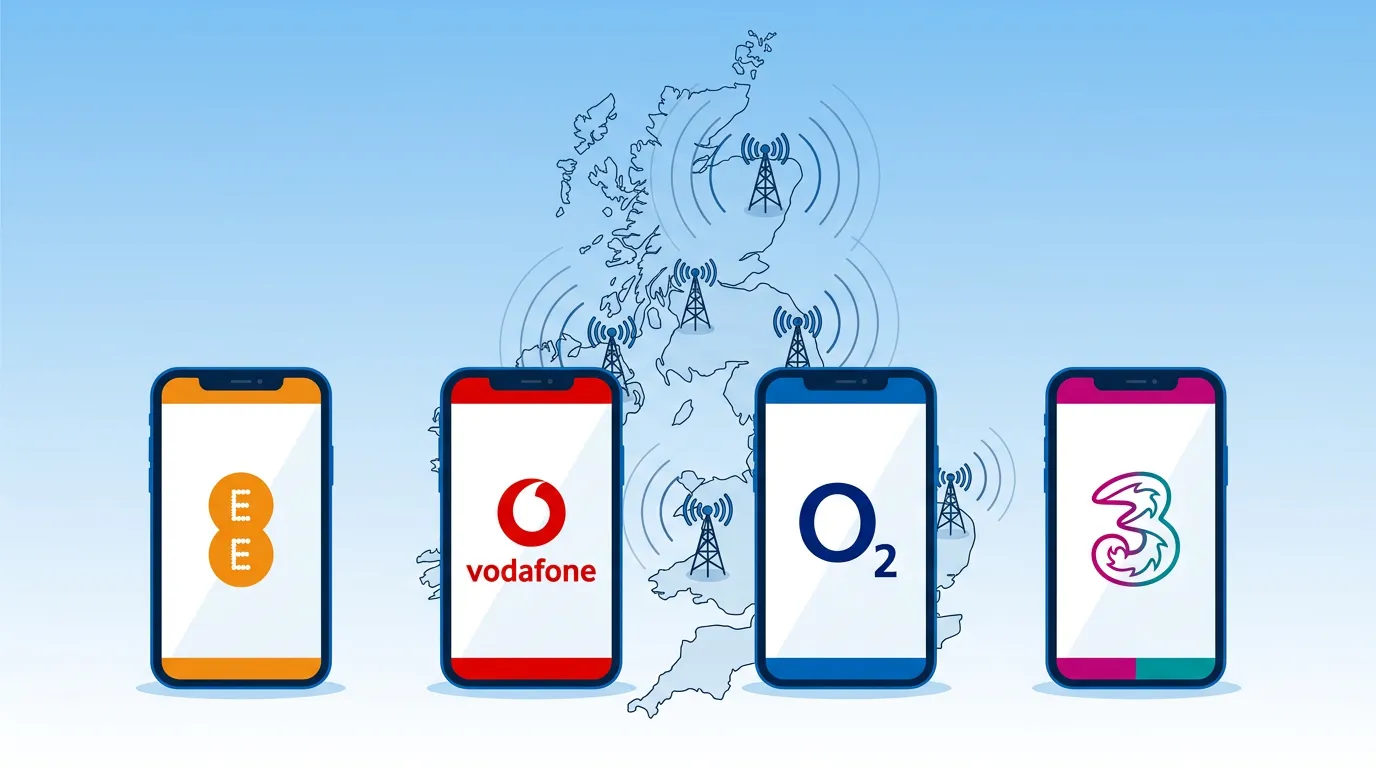
The UK has four UK mobile carriers — known as Mobile Network Operators (MNOs) — that own and run their own infrastructure:
- EE (owned by BT Group) — the UK’s largest mobile network by coverage and speed
- Vodafone — strong enterprise focus with the widest international roaming
- O2 (owned by Virgin Media O2 / Liberty Global) — known for flexible contracts and EU roaming
- Three (owned by CK Hutchison) — the value leader with the UK’s largest 5G footprint
Every other provider — from giffgaff to Tesco Mobile to Sky Mobile — is a virtual operator (MVNO) that piggybacks on one of these four networks. For business use, we almost always recommend going direct with an MNO (or through an authorised partner like Connection Technologies) rather than an MVNO, because you get priority network access, proper business support and fleet management tools that MVNOs simply cannot offer.
UK MVNOs in 2026 — and which network actually powers them
Free tool
Ranking the networks nationally only goes so far — signal is decided street by street. Before you switch, run our free mobile coverage checker to compare predicted EE, O2, Vodafone and Three signal (4G and 5G, with an interactive map) at your exact postcode.
The four mobile network operators (MNOs) above own the towers — but the UK has dozens of mobile virtual network operators (MVNOs) who lease capacity from those four. If you’re shopping for a personal SIM, an MVNO can be excellent value. If you’re buying mobiles for your business, the table below tells you which underlying network you’d actually be on, so you can match coverage where you live and work.
| MVNO brand | Runs on | What it’s known for |
|---|---|---|
| Asda Mobile | Vodafone | Pay-as-you-go and SIM-only; budget-focused with no business tariffs. |
| Smarty | Three | Three-owned MVNO; data refunds for unused allowance, popular with consumer SIM-only. |
| iD Mobile | Three | Carphone Warehouse / Currys MVNO; capped contracts and data rollover. |
| Lebara | Vodafone | Strong international call rates; aimed at consumers calling overseas. |
| Talkmobile | Vodafone | Vodafone’s own discount sub-brand; SIM-only at lower cost than Vodafone direct. |
| VOXI | Vodafone | Vodafone-owned; endless social media data on every plan. |
| Lycamobile | EE | International-call-focused MVNO with strong roaming-style data add-ons. |
| giffgaff | O2 | Goody-bag SIM-only model; no contracts, popular with consumers and freelancers. |
| Tesco Mobile | O2 | Clubcard-linked benefits; family bundles, monthly contracts. |
| Sky Mobile | O2 | Data rollover (3 years); discounts for Sky Broadband / TV customers. |
| 1pMobile | EE | Ultra-budget MVNO; pay-per-use plus capped £10/month options. |
| BT Mobile | EE | Now run as a business arm of EE itself; remains EE network underneath. |
Why we still recommend MNOs (or an authorised business partner) for business mobiles: MVNOs typically have lower-priority network access during congestion (so a busy event or train commute can drop your data speed before a direct EE/O2/Three/Vodafone customer notices). They also lack proper business-grade tools — fleet management, multi-line discounting, dedicated UK account managers, hardware leasing, mobile device management. For consumer use, MVNOs like Smarty, VOXI or iD Mobile are genuinely good value. For business, we still believe a direct MNO contract — or a partner-managed contract — wins on every metric that matters: priority access, support, hardware, and total cost over 24 months.
One genuine MVNO use-case for business: if you have a small fleet (under 5 lines) and want simple monthly billing with no contract lock-in, Tesco Mobile business or iD Mobile business plans can work well. For anything above 5 lines, the multi-line discounts and fleet tools available from EE Business, O2 Business, Three Business and Vodafone Business almost always win.
How do EE, O2, Three and Vodafone compare in August 2026?
Compare all UK networks in 60 seconds
Tell us how many handsets you need and when your contract expires — we\'ll return tailored quotes from EE, Vodafone, O2 and Three.
Compare networks for my postcode →The table below summarises the key metrics that matter for choosing the best mobile network UK businesses and consumers can rely on. All speed data reflects Opensignal’s January 2026 UK report (the most recent published), coverage figures are from Ofcom Connected Nations Spring 2026, and pricing is based on current published business tariffs as of May 2026.
| Metric | EE | Vodafone | O2 | Three |
|---|---|---|---|---|
| 4G Population Coverage | 99.8% | 99.5% | 99.6% | 99.5% |
| 5G Towns/Cities | 210+ | 150+ | 170+ | 370+ |
| Avg Download Speed (overall) | 53.2 Mbps | 37.5 Mbps | 32.8 Mbps | 51.0 Mbps |
| Avg Download Speed (5G) | 92.2 Mbps | 130.9 Mbps | 89.9 Mbps | 187 Mbps |
| Avg Upload Speed (overall) | 10.4 Mbps | 7.4 Mbps | 6.4 Mbps | 9.3 Mbps |
| 5G Availability (time on 5G) | 77.4% | 29.6% | 57.0% | 38.9% |
| Business SIM-Only From | £24/month | £23/month | £21/month | £20/month |
| Consumer SIM-Only From | £12/month | £11/month | £11/month | £9/month |
| Contract Lengths | 12 or 24 months | 12, 24 or 36 months | 12, 24, 36 months or 30-day rolling | 12 or 24 months |
| Roaming Destinations | 53 included | 83 included | EU included (47) | EU included (47) |
| Business Fleet Tools | Good | Excellent | Good | Basic |
| Unlimited Data Option | Yes (from £38/month) | Yes (from £35/month) | Yes (from £33/month) | Yes (from £28/month) |
| Our Rating | ⭐⭐⭐⭐⭐ (9.3/10) | ⭐⭐⭐⭐⭐ (9.2/10) | ⭐⭐⭐⭐ (8.5/10) | ⭐⭐⭐⭐ (8.0/10) |
Coverage figures based on Ofcom Connected Nations Spring 2026 data and network operator reports. Speed data from Opensignal UK Mobile Network Experience Report, January 2026 (data collected 1 October – 29 December 2025). Speeds vary by location, device and congestion. Speed data re-verified 28 August 2026 · Pricing verified May 2026 by Charlie Fisher · Next refresh: November 2026 · Excludes VAT.
What Ofcom and Opensignal don’t tell you (the B2B view)
Both Ofcom Connected Nations and Opensignal measure the consumer experience — billions of speed tests from personal phones, weighted to reflect the UK population. That methodology systematically under-weights what matters most to business buyers. Three caveats we apply when we recommend a network for an SME or fleet:
- Population coverage is the wrong metric for offices. A network that’s 99.5% population-covered can still have weak spots in industrial estates, business parks and shared serviced offices — the very places a disproportionate share of UK SMEs sit. We’ve seen postcodes inside Manchester’s Northern Quarter and Reading’s IQ business district where the “national winner” loses to the third-place network on indoor signal.
- Peak-time business-district congestion never appears in the headlines. The published speed averages smooth across 24 hours and the whole UK; real B2B usage clusters into 9-5 weekdays in city-centre postcodes, where contention behaves very differently. A mid-table average can mean a market-leading peak-time experience, or vice versa.
- Priority-access tiers are invisible to consumer benchmarks. EE Business+, Vodafone Business Premium and Three’s 5G Priority lanes deliberately keep paying business customers ahead of consumer congestion — but you’ll never see them measured in any Opensignal or Ofcom report, because their crowd-sourced apps don’t run on those SIM profiles. The tier you’re on materially changes the experience you actually get.
For business buyers, the only metric that matters is what speed and resilience your team gets at your actual postcodes during the hours you work. National averages are the starting point — never the answer. That’s why we always run a postcode-level coverage check across all four networks before recommending one.
🏆 Our pick for most businesses:Vodafone — the best balance of coverage, business tools, international roaming and price. For pure speed and rural coverage, EE wins. For budget-conscious SMEs, Three offers the most data for the money. Compare networks for my postcode →
Postcode-dependent winner
Not sure which network actually wins at your postcode?
National averages only tell part of the story. We’ll compare EE, Vodafone, O2 and Three at your business locations and contract size — free, in 60 seconds.
Free comparison · No obligation · All major UK networks
Is EE the best mobile network in the UK?
For most people asking “what is the best mobile network UK?”, EE is the answer. It has consistently topped Ofcom’s and Opensignal’s speed tests, was the first UK network to launch 5G back in 2019, and maintains the widest 4G footprint in the country. Backed by BT Group, EE has invested heavily in both 4G and 5G infrastructure, and the January 2026 Opensignal data confirms it remains the overall performance leader, taking 11 of the 15 awards.
EE coverage in 2026
EE’s 4G network reaches 99.8% of the UK population — the highest of any operator. Its geographic coverage (the actual land area covered, not just population) is also the strongest, making it the best mobile network for rural areas in many parts of the country. EE’s 5G network now covers over 210 towns and cities, with expansion into suburban and semi-rural areas continuing throughout 2026.
EE speeds (January 2026 Opensignal report)
Opensignal’s January 2026 report places EE’s average overall download speed at 53.2 Mbps — the highest of any UK network — and EE wins both overall speed awards outright, plus Reliability Experience (915 points out of 1,000) and Consistent Quality (78.6%). On 5G-only connections EE averages 92.2 Mbps — Three is faster on raw 5G speed — but EE’s users spend far more time actually connected to 5G than anyone else’s (77.4% 5G availability, the UK’s highest by a wide margin). For businesses that rely on mobile data for tethering, video calls or cloud applications, EE’s blend of speed, reliability and 5G availability is the strongest overall package.
EE business plans and pricing
EE’s business plans start from around £24 per month for a SIM-only deal with unlimited calls, texts and a generous data allowance. Multi-line discounts are available for businesses ordering five or more SIMs. EE’s business portal offers solid device management, usage analytics and the ability to set data caps per user — though it is not quite as feature-rich as Vodafone’s enterprise tools. Unlimited data business plans start from £38/month. Planning handset refreshes around Apple’s September launch? See our iPhone 18 release timeline and UK pricing guide — EE business plans typically list new iPhones from day one.
EE pros and cons
✅ Pros
- Fastest overall download and upload speeds in the UK (Opensignal January 2026)
- Widest 4G population coverage at 99.8%
- Best geographic (rural) coverage of any network
- Strong 5G rollout — 210+ towns, 15 added in Q1 2026
- BT Group backing ensures continued infrastructure investment
- Leading upload speeds and lowest latency
❌ Cons
- Most expensive business SIM-only (from £24/month)
- Only 53 roaming destinations included (vs Vodafone’s 83)
- No 30-day rolling contract option for businesses
- Business fleet tools lag behind Vodafone’s enterprise portal
- 5G town count (210+) is lower than Three’s (370+)
🏆 Our pick: EE is the best mobile network in the UK for speed, reliability and rural coverage. Choose EE if your business prioritises performance above all else.
Is Vodafone the best mobile network for businesses?
For businesses specifically — particularly those with multiple handsets, international travel requirements or a need for centralised device management — Vodafone is arguably the best mobile network UK companies can choose. While it does not quite match EE on raw speed, Vodafone’s enterprise-focused tools, wide roaming coverage and competitive business pricing make it the go-to choice for SMEs and larger organisations alike.
Vodafone coverage in 2026
Vodafone’s 4G network covers 99.5% of the UK population, fractionally behind EE and O2 but still excellent. Its 5G rollout reaches 150+ towns and cities — the smallest footprint of the four networks, though Vodafone has been prioritising depth of coverage (stronger signal in covered areas) over breadth. Indoor coverage performance is strong, and Vodafone’s network consistently performs well in dense urban environments where many businesses operate.
Vodafone speeds (January 2026 Opensignal report)
Vodafone’s average overall download speed is 37.5 Mbps — third of the four networks — while its 5G-only speeds average 130.9 Mbps, second only to Three. For most business applications including video conferencing, cloud file syncing and CRM access, these speeds are more than sufficient. Worth knowing: following the mid-2025 Vodafone–Three merger the two networks are still integrating, and Opensignal describes the UK market as being in a period of significant structural change — Vodafone’s performance is likely to shift as integration progresses.
Vodafone business plans and pricing
Vodafone’s business SIM-only plans start from £23 per month. What sets Vodafone apart is its business portal — enhanced in early 2026 with real-time data usage alerts per user, fleet-wide analytics and the ability to manage devices, set spend caps and allocate data pools across teams. Contract lengths of 12, 24 or 36 months offer flexibility, and multi-SIM discounts are generous for fleets of 10+. Roaming is included in 83 destinations — the widest of any UK network, which is a significant advantage for businesses with staff who travel beyond Europe. Unlimited data business plans start from £35/month.
Vodafone pros and cons
✅ Pros
- Best business fleet management tools in the UK (enhanced early 2026)
- Widest roaming — 83 destinations included
- Competitive business pricing from £23/month
- Fast 5G where available (130.9 Mbps average)
- Dedicated account management for businesses
- Flexible contract lengths including 36-month options
❌ Cons
- Smallest 5G footprint (150+ towns vs Three’s 370+)
- Slower than EE on both 4G and 5G
- No 30-day rolling business contract option
- 4G coverage (99.5%) fractionally behind EE (99.8%)
- Consumer pricing not as competitive as Three
🏆 Our pick: Vodafone is the best mobile network for UK businesses that need fleet management, international roaming and dedicated support. Best for companies with 5+ handsets.
Is O2 a good mobile network for UK businesses?
O2 — now part of Virgin Media O2 — occupies a strong middle ground in the UK mobile market. It is not the fastest or the cheapest, but it offers a compelling combination of flexibility, fair pricing and solid coverage that makes it an excellent choice for SMEs that value adaptable contracts and straightforward EU roaming.
O2 coverage in 2026
O2’s 4G network reaches 99.6% of the UK population, placing it second behind EE. Its 5G rollout now covers 170+ towns and cities — a notable improvement over 2025 — and continues to expand. O2’s network sharing agreement with Vodafone (the CTIL joint venture) means both operators benefit from shared mast infrastructure in many areas, giving O2 strong indoor coverage in urban and suburban environments.
O2 speeds (January 2026 Opensignal report)
O2’s average overall download speed is 32.8 Mbps — the lowest of the four — with 5G-only speeds averaging 89.9 Mbps. But raw speed has never been O2’s pitch: it wins Opensignal’s overall Coverage Experience award — the best-rated coverage of any UK network — and its 5G availability (57%) is second only to EE. While the speed figures trail the competition, they are perfectly adequate for most business use cases, and O2’s network tends to perform consistently — fewer speed spikes but also fewer drops during peak hours in built-up areas.
O2 business plans and pricing
O2’s business SIM-only plans start from £21 per month, offering good value in the mid-range. The standout development in 2026 is O2’s new 30-day rolling business contract — available for up to 10 SIMs with no minimum term. This is ideal for project-based businesses, seasonal operations or companies that want to trial a network before committing. Standard contracts run for 12, 24 or 36 months. EU roaming is included across 47 destinations as standard. Unlimited data business plans start from £33/month.
O2 pros and cons
✅ Pros
- New 30-day rolling business contracts — best flexibility in the market
- EU roaming included across 47 destinations
- Competitive mid-tier pricing from £21/month
- Strong 4G coverage at 99.6% population
- Consistent network performance with fewer peak-time drops
- Shared mast infrastructure with Vodafone improves indoor coverage
❌ Cons
- Slowest overall download speed (32.8 Mbps) — though coverage, not speed, is O2’s strength
- Only 47 roaming destinations (EU only) vs Vodafone’s 83
- 30-day rolling contracts limited to 10 SIMs maximum
- Business fleet tools rated “Good” but not as advanced as Vodafone’s
- 5G footprint (170+) smaller than EE or Three
🏆 Our pick: O2 is the best mobile network for UK businesses that need contract flexibility — especially with the new 30-day rolling option. Ideal for startups, seasonal businesses and companies testing a network before committing.
Is Three the best value mobile network in the UK?
Three is the best value mobile network in the UK — and it has the largest 5G footprint of any operator. If your business operates in a 5G-covered area and you want to keep costs low without sacrificing data allowances, Three deserves serious consideration. However, it does trail the other networks on raw speed and business tools.
Three coverage in 2026
Three’s 4G network covers 99.5% of the UK population — level with Vodafone but slightly behind EE and O2. Where Three really stands out is 5G: its network now reaches 370+ towns and cities, making it the UK’s largest 5G footprint by a significant margin. Three achieved this by aggressively deploying mid-band 5G spectrum across smaller towns that other operators have not yet reached. For businesses in these locations, Three offers a genuine 5G advantage.
Three speeds (January 2026 Opensignal report)
Three is no longer the slow network of old. Opensignal’s January 2026 report gives Three the UK’s fastest 5G download speed at 187 Mbps — roughly double EE’s 92.2 Mbps — along with the fastest 5G uploads (20.2 Mbps) and the highest time-on-network figure of any operator (99.4%). The trade-off is 5G availability: Three’s users spend 38.9% of their time connected to 5G versus EE’s 77.4%, so those headline 5G speeds depend on being somewhere Three’s 5G actually reaches. In 5G-covered towns, Three now delivers genuinely flagship-level performance at the cheapest prices of any UK network.
Three business plans and pricing
Three’s business SIM-only plans start from just £20 per month — the cheapest of any UK network. In Q1 2026, Three launched new business SIM-only tiers with 5G priority access from £22/month, aimed specifically at SMEs upgrading from consumer plans. Unlimited data business plans start from £28/month — significantly cheaper than the competition. Contract lengths are 12 or 24 months. Three’s business management portal is basic compared to Vodafone’s and EE’s, offering essential features but lacking advanced fleet analytics.
Three pros and cons
✅ Pros
- Cheapest business SIM-only from £20/month
- Cheapest unlimited data from £28/month
- Largest 5G footprint in the UK — 370+ towns and cities
- New 5G priority business tiers from £22/month
- Good option for SMEs upgrading from consumer plans
❌ Cons
- 5G availability (38.9% time-on-5G) well behind EE — the fast 5G only helps where 5G reaches
- Basic business management portal — lacks advanced fleet tools
- Only EU roaming included (47 destinations)
- No 30-day rolling business contract option
- Network integration with Vodafone still underway following the 2025 merger
- 4G coverage (99.5%) fractionally behind EE
🏆 Our pick: Three is the best value mobile network in the UK. Choose Three if your business needs affordable unlimited data or operates in one of the 370+ 5G towns. Best for small businesses and sole traders watching their budget.
What is the best mobile network for rural areas in the UK?
If you work in rural parts of the UK — farms, construction sites, field sales territories or remote offices — coverage matters more than speed. The best mobile network for rural UK areas is EE. Its 4G geographic coverage (land area, not just population) leads the pack, and BT Group’s continued investment in the Shared Rural Network (SRN) programme means EE’s rural footprint continues to expand in 2026.
That said, coverage varies enormously by postcode. A network that is excellent in rural Devon may have gaps in the Scottish Highlands, and vice versa. This is why we always recommend checking coverage at your specific postcode before committing.
| Network | 4G Geographic Coverage | 4G Population Coverage | Rural Performance |
|---|---|---|---|
| EE | ~87% | 99.8% | ⭐⭐⭐⭐⭐ Best |
| O2 | ~83% | 99.6% | ⭐⭐⭐⭐ Good |
| Vodafone | ~82% | 99.5% | ⭐⭐⭐⭐ Good |
| Three | ~80% | 99.5% | ⭐⭐⭐ Adequate |
Geographic coverage estimates based on Ofcom Connected Nations Spring 2026 data. Actual coverage varies by terrain, building materials and local conditions.
🏆 Best for rural areas: EE — widest geographic 4G coverage and strongest rural signal.
Which mobile network has the best 5G coverage in the UK?
Three has the largest 5G footprint in the UK, covering 370+ towns and cities — nearly double EE’s count. However, “5G coverage” requires nuance. Three’s 5G reaches more towns and is now the fastest in the UK where you can get it (187 Mbps average), but EE’s users spend the most time actually connected to 5G — 77.4% versus Three’s 38.9%. Vodafone and O2 fall somewhere in between.
| Network | 5G Towns/Cities | Avg 5G Download Speed | 5G Quality Rating |
|---|---|---|---|
| Three | 370+ | 187 Mbps | ⭐⭐⭐⭐⭐ Fastest + widest reach |
| EE | 210+ | 92.2 Mbps | ⭐⭐⭐⭐⭐ Best availability (77.4%) |
| O2 | 170+ | 89.9 Mbps | ⭐⭐⭐⭐ Solid |
| Vodafone | 150+ | 130.9 Mbps | ⭐⭐⭐⭐ Fast where available |
For businesses in smaller towns that already have Three’s 5G, Three is the clear winner. For businesses in major cities that need the fastest possible connection, EE’s 5G is superior. If 5G is not yet available in your area, focus on 4G performance instead — where EE leads across the board.
🏆 Best 5G coverage: Three (widest reach at 370+ towns, 187 Mbps average — the UK’s fastest). Best 5G availability: EE (connected 77.4% of the time).
Which mobile network is cheapest for business SIM-only in 2026?
Price matters — especially for small businesses ordering multiple SIMs. Here is how the four networks compare on business SIM-only pricing (verified May 2026):
| Network | Entry Business SIM-Only | Mid-Tier (25–50 GB) | Unlimited Data | Multi-SIM Discount |
|---|---|---|---|---|
| Three | £20/month | £22–£26/month | £28/month | Available (5+) |
| O2 | £21/month | £25–£29/month | £33/month | Available (3+) |
| Vodafone | £23/month | £27–£31/month | £35/month | Available (5+) |
| EE | £24/month | £28–£34/month | £38/month | Available (5+) |
Pricing verified May 2026 by Charlie Fisher · Next refresh: August 2026 · Excludes VAT. Final pricing depends on contract length, data allowance and number of SIMs ordered.
Three is the cheapest across every tier, including unlimited data. However, price alone should not drive the decision — Three’s slower speeds and basic business tools may cost you in other ways. For many businesses, the extra £3–£5 per SIM for Vodafone or EE pays for itself in faster performance and better management tools.
🏆 Cheapest business SIM-only: Three from £20/month. Best value for money: O2 from £21/month (with 30-day flexibility).
Which mobile network is best for international roaming?
If your team travels for business — whether within Europe or further afield — roaming costs can add up quickly on the wrong plan. Here is how the networks compare:
| Network | Included Roaming Destinations | EU Roaming | Non-EU Roaming | Daily Roaming Cap |
|---|---|---|---|---|
| Vodafone | 83 | Included | 36 additional destinations included | Varies by destination |
| EE | 53 | Included | 6 additional destinations included | £2–£6/day outside included zones |
| O2 | 47 | Included | Pay-as-you-go or travel bolt-ons | Varies by bolt-on |
| Three | 47 | Included | Pay-as-you-go or travel bolt-ons | Varies by bolt-on |
Vodafone is the clear winner for international roaming, with 83 destinations included as standard — 36 of which are outside Europe. This is a significant advantage for businesses with staff travelling to the US, UAE, Australia, Singapore, Hong Kong and other key business destinations. EE’s 53 included destinations offer a reasonable middle ground. O2 and Three cover EU roaming but charge extra beyond Europe.
🏆 Best for roaming: Vodafone — 83 destinations included, with 36 outside Europe. Essential for internationally-mobile businesses.
How do I choose the best mobile network for my business?
The “best” network depends on your specific circumstances. Use this decision framework:
| Your Priority | Best Network | Why |
|---|---|---|
| Fastest overall experience | EE | 53.2 Mbps overall download, 11 of 15 Opensignal awards, best 5G availability |
| Rural / remote coverage | EE | 99.8% population coverage, strongest geographic footprint |
| Best business tools | Vodafone | Enterprise fleet management, spend caps, real-time analytics |
| International roaming | Vodafone | 83 destinations included — 36 outside Europe |
| Cheapest price | Three | Business SIM-only from £20/month, unlimited from £28/month |
| Fastest 5G & widest 5G footprint | Three | 187 Mbps average 5G across 370+ towns — nearly double EE’s 5G footprint |
| Contract flexibility | O2 | New 30-day rolling business contracts for up to 10 SIMs |
| EU travel only | O2 or Three | EU roaming included at lower price points |
| 10+ handsets / fleet | Vodafone | Best multi-SIM discounts and fleet management portal |
| Sole trader / 1–3 SIMs | Three or O2 | Best value at lower volumes, flexible terms |
🤔 Still not sure? The quickest way to find the best network for your business is to tell us what you need. We will check live coverage at your postcode, compare pricing across all four networks and send you a side-by-side quote — free, no obligation. Compare networks for my postcode →
Why use Connection Technologies to get your business mobile deal?
Connection Technologies is an authorised UK business telecoms partner for all four major networks. Here is why thousands of UK businesses use us rather than going direct:
- All four networks, one quote: We compare EE, Vodafone, O2 and Three side by side so you do not have to request four separate quotes.
- Postcode-level coverage checks: We check actual signal strength at your premises and key locations — not just the broad coverage maps on each network’s website.
- Business-only pricing: We access wholesale business tariffs that are not available on network websites or in retail stores.
- Free, no-obligation quotes: We send a tailored comparison within 2 hours — no sales pressure, no hidden fees.
- Ongoing support: Dedicated account management, help with network switches, SIM deployment and ongoing optimisation.
📞 Get Your Free Business Mobile Quote
Tell us your postcode, number of SIMs and data requirements. We will compare all four networks and send you a tailored, no-obligation quote within 2 hours.
Frequently asked questions about UK mobile networks
What is the best mobile network in the UK in 2026?
EE is the best overall mobile network in the UK in 2026. It has the fastest overall download speeds (53.2 Mbps), 11 of Opensignal’s 15 UK awards, the widest 4G population coverage (99.8%) and a strong 5G rollout across 210+ towns. For businesses specifically, Vodafone offers the best business support tools and widest roaming, while Three is the best value from £20/month.
Which UK mobile network has the best coverage?
EE has the best coverage in the UK. Its 4G network reaches 99.8% of the UK population — the highest of any operator. EE also has the widest geographic (land area) coverage, making it the best choice for rural areas. All four networks now exceed 99% indoor 4G premises coverage as of spring 2026.
Which is the cheapest mobile network for business in the UK?
Three is the cheapest UK mobile network for business. Business SIM-only plans start from £20/month, and unlimited data business plans start from £28/month. O2 is the next cheapest from £21/month with the added benefit of 30-day rolling contracts.
Is 5G worth it for businesses in 2026?
5G can be worth it if your business operates in a covered area and relies on data-intensive tasks like video conferencing, large file transfers or cloud applications. Average 5G-only speeds range from 89.9 Mbps (O2) to 187 Mbps (Three) — significantly faster than 4G. However, 4G remains perfectly adequate for most business use cases, and 5G coverage is still patchy outside major towns. Check 5G availability at your postcode before making it a deciding factor.
Should I use an MVNO or a main network for business?
For business use, we recommend going direct with a main network operator (EE, Vodafone, O2 or Three) or through an authorised partner like Connection Technologies. Main networks offer priority network access, dedicated business support, fleet management tools and multi-SIM discounts that MVNOs cannot match. MVNOs can be cheaper for personal use, but the savings rarely justify the trade-offs for business.
Can I keep my number when switching mobile networks?
Yes. You can port your existing business mobile number(s) to any UK network. The process typically takes one working day. If you get a quote through Connection Technologies, we handle the porting process for you at no extra cost.
Why is my mobile signal poor at my office or business address?
Poor mobile signal at a fixed business address usually comes from one of three things — building materials (modern offices with foil-backed insulation, low-emissivity glass and steel framing block radio waves), the nearest mast being on a different network than your handset, or being on the edge of a 4G cell where the network is downgrading you to weaker bands. The fix isn’t always to switch networks: a postcode-level check across EE, Vodafone, O2 and Three usually shows that one network has a much closer mast to your premises than the others. For chronic indoor signal issues, we can also configure Wi-Fi calling on every business handset, or deploy an Ofcom-licensed mobile signal booster — both of which are dramatically cheaper than switching contracts.
How do I check which mobile network has the best coverage in my area?
Three options. (1) Each network publishes a coverage checker on its own website — useful but optimistic, because they all map predicted rather than measured signal. (2) Ofcom’s mobile coverage checker aggregates predicted data from all four networks in one map and is more honest about edge cases. (3) For a real B2B answer, give us your postcode and we’ll cross-reference all four networks’ actual signal strength at your premises — including indoor predictions, 4G band coverage and 5G availability — and send you a side-by-side report. That’s free, takes 60 seconds and you don’t have to commit to anything.
See also our guide on Mobile Network Coverage Checker UK: Compare Signal Strength Across Networks for more details.
See also our guide on Company Work Mobiles: Best Value Plans for UK Businesses in 2026 for more details.
See also our guide on Business Mobile Plans UK 2026: 47 Tariffs Compared Side by Side for more details.
Which UK mobile networks support real Wi-Fi calling for business handsets?
All four UK networks (EE, Vodafone, O2 and Three) support Wi-Fi calling on most modern business handsets — but support quality and feature parity varies. EE and Vodafone enable Wi-Fi calling automatically across iPhone, Samsung Galaxy and Pixel business plans without configuration. O2 supports it on most business plans but you may need to enable it manually in the device’s settings. Three’s Wi-Fi calling rolled out widely during 2024-25 and now covers most current handsets. For office environments with weak indoor mobile signal, Wi-Fi calling is usually the cheapest fix — better than switching networks if your existing contract is otherwise working.
Are MVNOs like Smarty, VOXI or giffgaff a credible option for business mobiles?
MVNOs ride on the four UK networks (Smarty and iD Mobile on Three; VOXI, Talkmobile and Lebara on Vodafone; giffgaff, Tesco Mobile and Sky Mobile on O2; 1pMobile and BT Mobile on EE) and on paper deliver the same coverage as their host network. In practice, MVNO traffic is deprioritised during congestion — so a busy commute, sports event or city-centre lunchtime can drop your data speed before a direct customer of the same network notices. For sole traders and very small teams (1-3 lines) where cost is the deciding factor, MVNOs like Smarty or Tesco Mobile Business work well. For 5+ lines, multi-line discounts, fleet management tools, dedicated UK business support and priority-access tiers from a direct EE / O2 / Three / Vodafone contract almost always win on total cost over 24 months.
Related Reading
- limited company mobile phone contracts
- business mobile fleet pricing for 5, 10 or 50+ lines
- cancelling a business mobile contract early
Business mobile deals near you
Local guides for UK cities and business sectors. Same plans we recommend across the country, with prices and SLAs that match each market.
Related Guides
Need to share your connection on the go? Read our Mobile Hotspot & Tethering Guide →
Comparing providers side by side? See our EE vs O2 vs Three vs Vodafone →
Need sector-specific network recommendations? Read our Mobile Plans by Industry →
Want a full side-by-side breakdown of EE vs O2 vs Three vs Vodafone? Read our Mobile Network Comparison UK 2026 →
Ready to see live business mobile packages?
We have current Vodafone and O2 deals from £8/mo with handset bundles, EU/global roaming and 36-month business contracts. See our business mobile packages UK →
Explore More Business Solutions
We help UK businesses save on telecoms, IT and connectivity.
Also worth a look